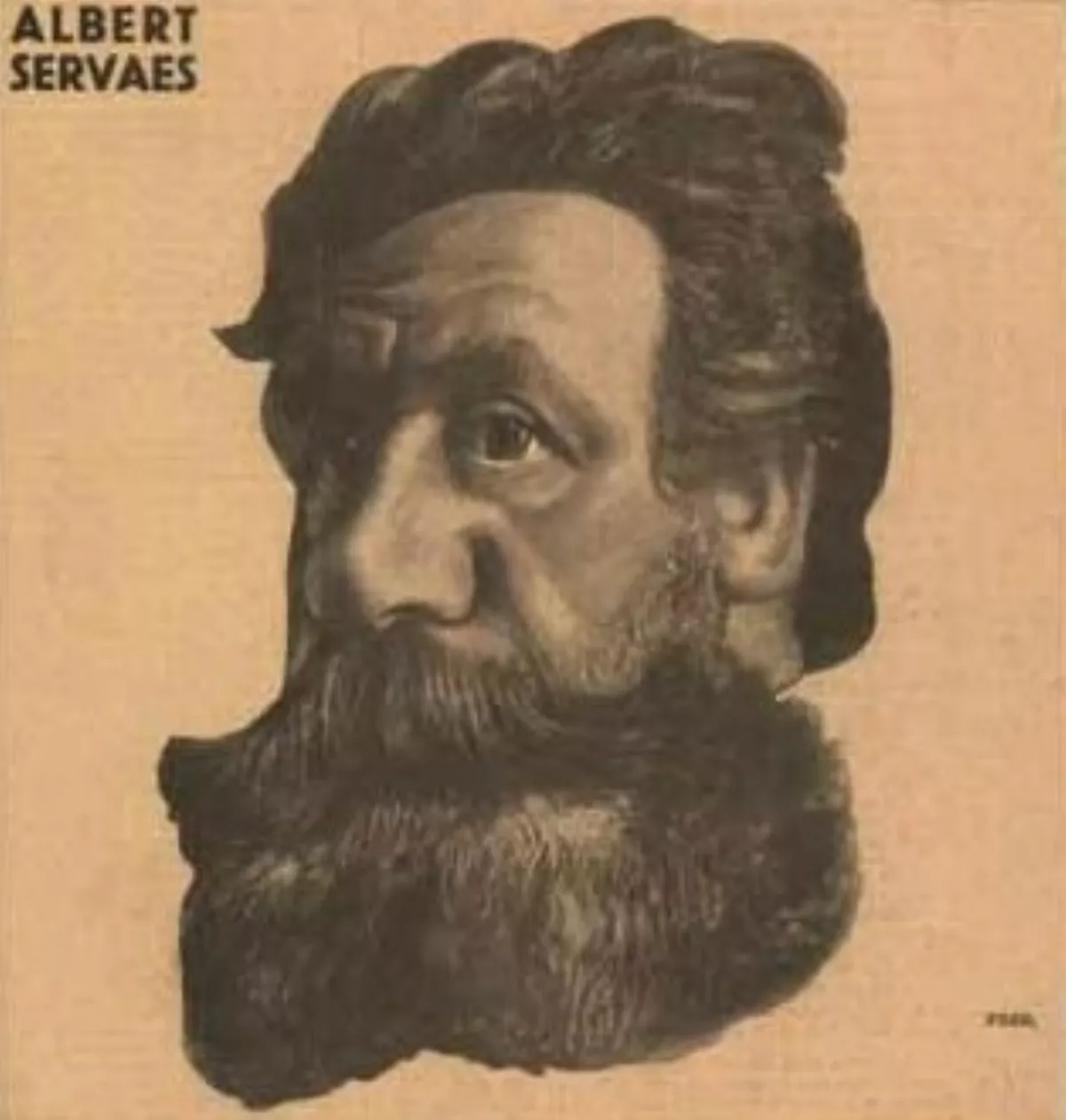
 1.
1. Albert Servaes was a Belgian expressionist painter.
 1.
1. Albert Servaes was a Belgian expressionist painter.
Albert Servaes was associate with but not a member of the first Latem School of painting which focused on Mystical Realism.
Albert Servaes is known for his religious works, typically showing the suffering of Jesus Christ, which stirred a conflict within the Catholic Church.
Albert Servaes was born in Ghent, Belgium in a middle class family engaged in retail activities.
Albert Servaes moved in 1904 to the rustic village of Sint-Martens-Latem outside of Ghent.
From 1905 Albert Servaes became interested in religion and mysticism while living in Sint-Martens-Latem and befriended members of a local church community.
Albert Servaes joined Verdinaso, a right wing authoritarian political party which had grown out of the Flemish Movement.
Albert Servaes collaborated with the occupier in its control over the cultural life in Belgium.
Albert Servaes was chairman of the Oost-Vlaamse Federatie voor Kunstenaars and a member of the Nederlandsche Kultuurkamer, an institution set up by the German occupier, which all artists, architects, writers, journalists, musicians, film actors and stage performers had to join in order to be allowed to work.
Albert Servaes was a member of the Duitsch-Vlaamsche Arbeidsgemeenschap which in May 1941 was incorporated in the occupier's SS structures.
Albert Servaes attended the German culture days in Cologne in May 1941, along with August Borms and Rob van Roosbroeck.
Albert Servaes received favourable press releases and was able to participate in group exhibitions in Germany.
Albert Servaes made some clear pro-German statements and linked his art to the cultural propaganda of the New Order.
Albert Servaes created some murals in the improvised chapel in the internment camp.
Albert Servaes was released from the internment centre by the end of 1945.
Albert Servaes remained a resident of Lucern in Switzerland for the rest of his life.
Common themes of Albert Servaes' paintings were landscapes, agricultural scenes, and subjects from the Bible.
Albert Servaes experimented with different ways to show his personal emotions through his paintings.
Albert Servaes combined this technique with a use of earth colors to create a gloomy tone in many of his works.
Albert Servaes used rough brushstrokes, in simple areas of thickly applied dark earth colours, to create a synthetic image of a banal field of stubble at the edge of a wood.
Albert Servaes' 1919 Stations of the Cross of Luithagen was a collection of 14 charcoal drawings depicting religious figures, such as an emaciated Jesus Christ on the cross.
Albert Servaes focused on landscape paintings after the controversy and before World War II began.
However, Albert Servaes did not give up his grim exclusively-charcoal technique permanently.