 1.
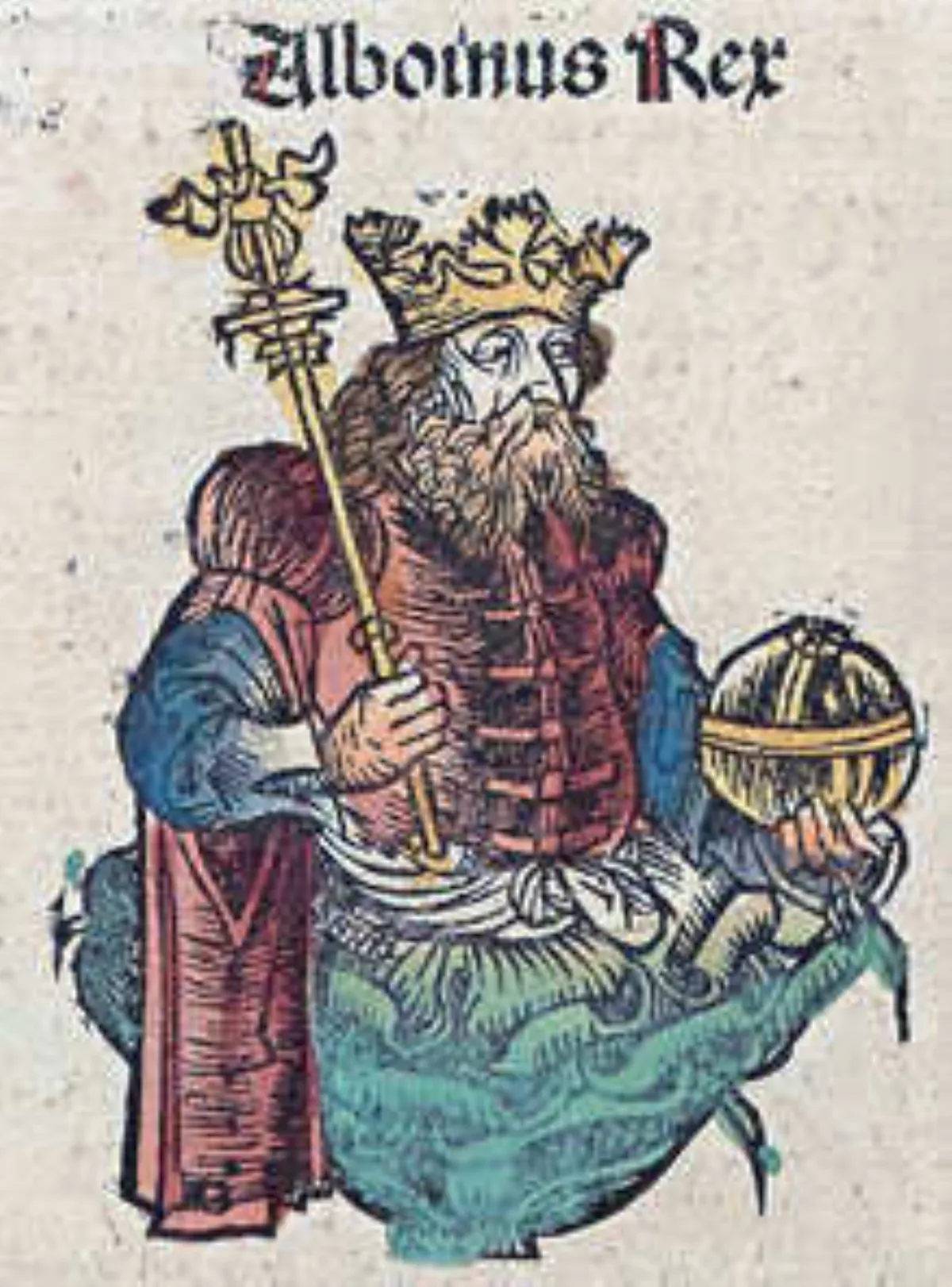
1. Alboin was king of the Lombards from about 560 until 572.
 1.
1. Alboin was king of the Lombards from about 560 until 572.
Alboin had a lasting effect on Italy and the Pannonian Basin; in the former, his invasion marked the beginning of centuries of Lombard rule, and in the latter, his defeat of the Gepids and his departure from Pannonia ended the dominance there of the Germanic peoples.
The Gepids initially gained the upper hand, but in 567, thanks to his alliance with the Avars, Alboin inflicted a decisive defeat on his enemies, whose lands the Avars subsequently occupied.
Alboin rapidly took control of most of Venetia and Liguria.
The coup failed in the face of opposition from a majority of the Lombards, who elected Cleph as Alboin's successor, forcing Helmichis and Rosamund to flee to Ravenna under imperial protection.
Alboin's death deprived the Lombards of the only leader who could have kept the newborn Germanic entity together, the last in the line of hero-kings who had led the Lombards through their migrations from the vale of the Elbe to Italy.
Alboin was probably born in the 530s in Pannonia, the son of Audoin and his wife, Rodelinda.
Alboin took as his first wife the Christian Chlothsind, daughter of the Frankish King Chlothar.
However, the Prosopography of the Later Roman Empire interprets events and sources differently, believing that Alboin married Chlothsind when already a king in or shortly before 561, the year of Chlothar's death.
Alboin first distinguished himself on the battlefield in a clash with the Gepids.
Alboin came to the throne after the death of his father, sometime between 560 and 565.
An account of the war by the Byzantine Theophylact Simocatta sentimentalises the reasons behind the conflict, claiming it originated with Alboin's vain courting and subsequent kidnapping of Cunimund's daughter Rosamund, that Alboin proceeded then to marry.
In 567 the allies made their final move against Cunimund, with Alboin invading the Gepids' lands from the northwest while Bayan attacked from the northeast.
Historians consider this the decisive factor in convincing Alboin to undertake a migration, even though there are indications that before the war with the Gepids a decision was maturing to leave for Italy, a country thousands of Lombards had seen in the 550s when hired by the Byzantines to fight in the Gothic War.
Nevertheless, the Lombards viewed Italy as a rich land which promised great booty, assets Alboin used to gather together a horde which included not only Lombards but many other peoples of the region, including Heruli, Suebi, Gepids, Thuringii, Bulgars, Sarmatians, the remaining Romans and a few Ostrogoths.
The precise size of the heterogeneous group gathered by Alboin is impossible to know, and many different estimates have been made.
The road followed by Alboin to reach Italy has been the subject of controversy, as is the length of the trek.
Alboin chose this walled town close to the frontier to be capital of the Duchy of Friuli and made his nephew and shield bearer, Gisulf, duke of the region, with the specific duty of defending the borders from Byzantine or Avar attacks from the east.
From Forum Iulii, Alboin next reached Aquileia, the most important road junction in the northeast, and the administrative capital of Venetia.
From Aquileia, Alboin took the Via Postumia and swept through Venetia, taking in rapid succession Tarvisium, Vicentia, Verona, Brixia and Bergomum.
The Lombards faced difficulties only in taking Opitergium, which Alboin decided to avoid, as he similarly avoided tackling the main Venetian towns closer to the coast on the Via Annia, such as Altinum, Patavium, Mons Silicis, Mantua and Cremona.
Alboin counted the years of his reign from the capture of Milan when he assumed the title of dominus Italiae.
Alboin's success meant the collapse of Byzantine defences in the northern part of the Po plain, and large movements of refugees to Byzantine areas.
However, most of the suffragan bishops in the north sought an accommodation with the Lombards, as did in 569 the bishop of Tarvisium, Felix, when he journeyed to the Piave river to parley with Alboin, obtaining respect for the Church and its goods in return for this act of homage.
Yet according to Walter Pohl the regions directly occupied by Alboin suffered less devastation and had a relatively robust survival rate for towns, whereas the occupation of territory by autonomous military bands interested mainly in raiding and looting had a more severe impact, with the bishoprics in such places rarely surviving.
The first attested instance of strong resistance to Alboin's migration took place at the town of Ticinum, which he started to besiege in 569 and captured only after three years.
Additionally, the difficulties encountered by Alboin in building a solid political entity resulted from a lack of imperial legitimacy, as, unlike the Ostrogoths, they had not entered Italy as foederati but as enemies of the Empire.
Alboin had in the meantime chosen Verona as his seat, establishing himself and his treasure in a royal palace built there by Theodoric.
Alboin had previously fallen in love with one of her husband's servants, and after the assassination tried to escape with him, but they were captured and killed.
Alboin's sword was removed, leaving him defenceless when Peredeo entered his room and killed him.
Alboin's death had a lasting impact, as it deprived the Lombards of the only leader they had that could have kept together the newborn Germanic entity.
Alboin's end represents the death of the last of the line of hero-kings that had led the Lombards through their migrations from the Elbe to Italy.
Alboin's fame survived him for many centuries in epic poetry, with Saxons and Bavarians celebrating his prowess in battle, his heroism, and the magical properties of his weapons.