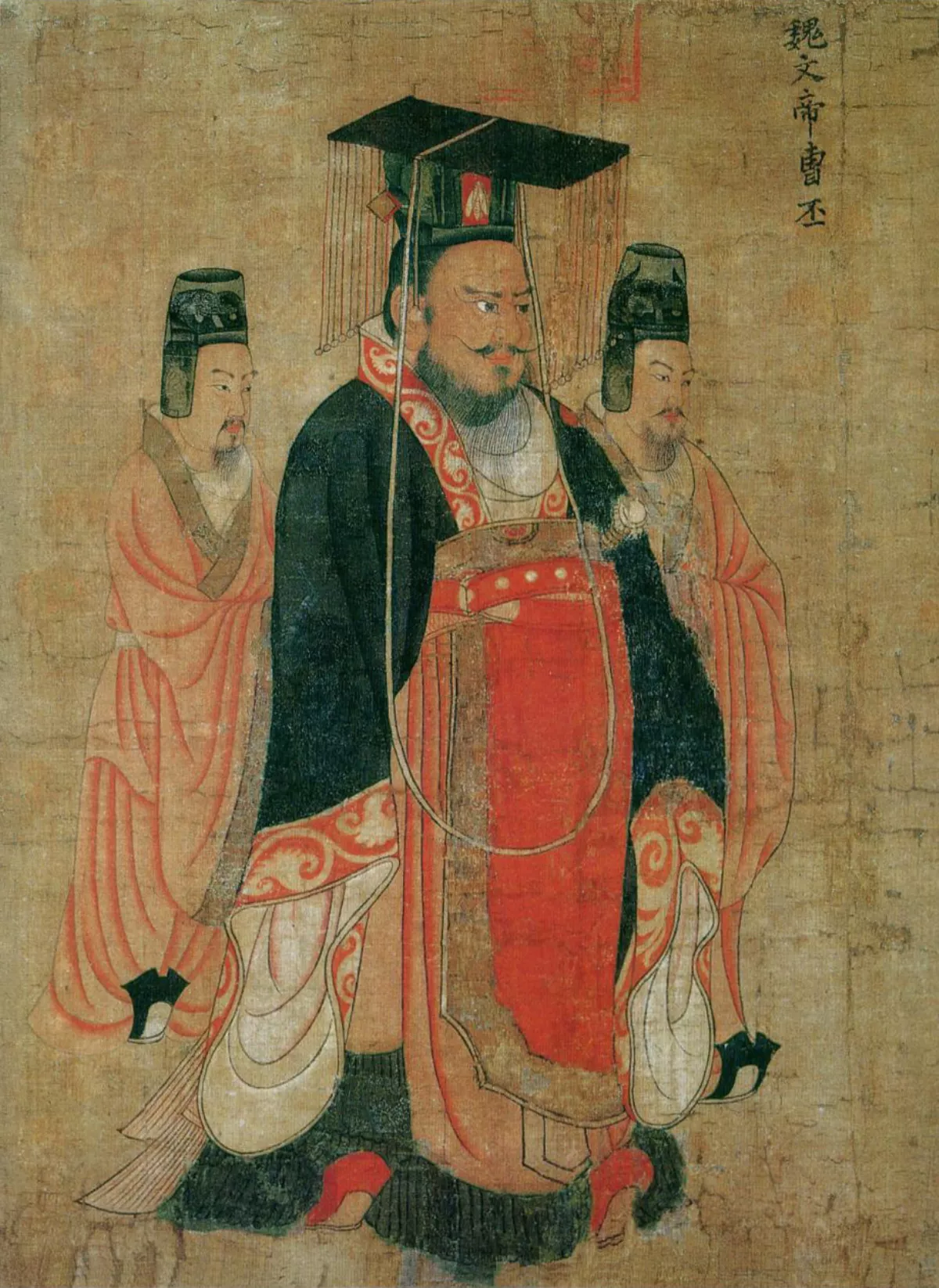
 1.
1. Cao Pi was the second son of Cao Cao, a warlord who lived in the late Eastern Han dynasty, but the eldest son among all the children born to Cao Cao by his concubine, Lady Bian.
 1.
1. Cao Pi was the second son of Cao Cao, a warlord who lived in the late Eastern Han dynasty, but the eldest son among all the children born to Cao Cao by his concubine, Lady Bian.
Cao Pi was mostly in charge of defence at the start of his career.
Cao Pi continued the wars against the states of Shu Han and Eastern Wu, founded by his father's rivals Liu Bei and Sun Quan respectively, but did not make significant territorial gain in the battles.
Unlike his father, Cao Pi concentrated most of his efforts on internal administration rather than on waging wars against his rivals.
Cao Pi was an accomplished poet and scholar, just like his father Cao Cao and his younger brother Cao Zhi.
Cao Pi wrote Yan Ge Xing, the first Chinese poem in the style of seven syllables per line.
Cao Pi wrote over a hundred articles on various subjects.
Cao Pi was the eldest son of Cao Cao and his concubine Lady Bian, but he was the second among all of Cao Cao's sons, the eldest being Cao Ang.
At the time of Cao Pi's birth, Cao Cao was a mid-level officer in the imperial guards in the capital Luoyang, with no hint that he would go on to the great campaigns he eventually carried out after the collapse of the imperial government in 190.
Cao Pi was recorded as excellent swordsman as he studied martial arts from Shi E, a gentleman of the household from the "Rapid as Tigers" division of the imperial guards.
The next immediate reference to Cao Pi's activities was in 211, when he was appointed General of the Household for All Purposes and Vice Imperial Chancellor.
The eldest of all of Cao Cao's sons, Cao Ang, had died early, so Cao Pi was regarded as the eldest among all his father's sons.
Besides, Cao Pi's mother had become Cao Cao's official spouse after Cao Cao's first wife Lady Ding was deposed.
Cao Pi thus became the presumptive heir to his father.
Cao Pi was fostering his image among the people and created the sense that Cao Zhi was wasteful and lacking actual talent in governance.
Cao Pi then ordered his brothers, including Cao Zhang and Cao Zhi, to return to their respective fiefs.
Cao Pi granted posthumous titles of emperors to his grandfather Cao Song and his father Cao Cao, while his mother Queen Dowager Bian became empress dowager.
Cao Pi moved the imperial capital from Xuchang to Luoyang.
Cao Pi declined this suggestion, in a fateful choice that most historians believe doomed his empire to ruling only northern and central China; such an opportunity would not come again.
Indeed, against Liu Ye's advice, Cao Pi granted Sun Quan the title "King of Wu" and the nine bestowments.
Cao Pi's forces were not able to make significant advances against them despite several large-scale attacks in the next few years.
Cao Pi was generally viewed as a competent, but unspectacular, administrator of his empire.
Cao Pi commissioned a number of capable officials to be in charge of various affairs of the empire, employing his father's general guidelines of valuing abilities over heritage.
Since Cao Pi was still fearful and resentful of Cao Zhi, he soon had the latter's fief reduced in size and had a number of his associates executed.
Cao Pi further gave the deceased Yu Jin a negative-sounding posthumous title, "Marquis Li", for people to remember the latter as the "stony marquis ".
An immediate issue after Cao Pi became emperor in 220 was who the empress would be.
Cao Pi did not appear to have seriously considered any other son as heir.
How Cao Pi became an emperor is portrayed in "Secret of the Three Kingdoms".
Cao Pi appears as a playable character in Koei's Dynasty Warriors and Warriors Orochi video game series.
Cao Pi appears in Koei's Romance of the Three Kingdoms series.
Cao Pi appears in Total War: Three Kingdoms, who appears as a child in 187 to 200 but comes of age in 203.