 1.
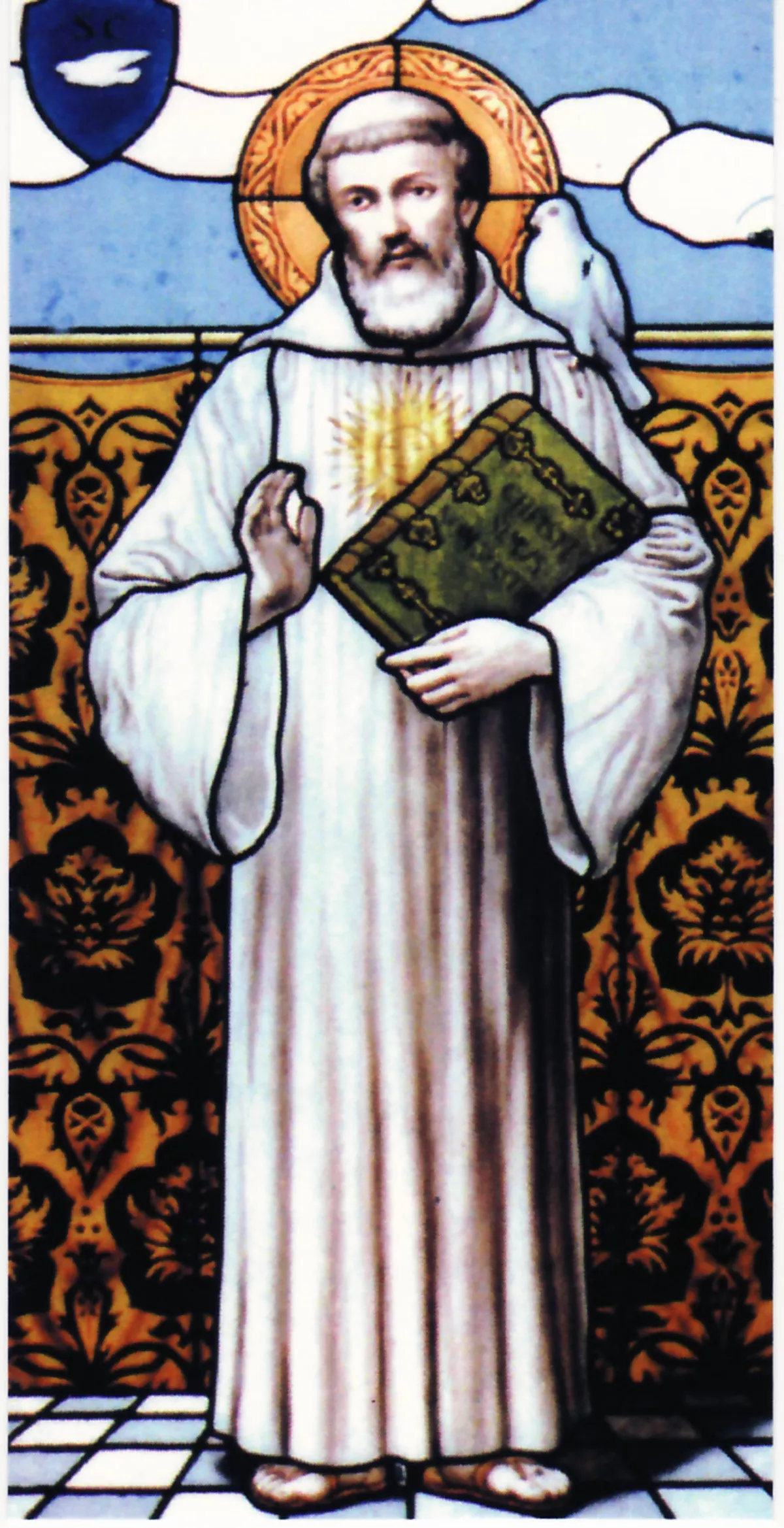
1. Saint Columbanus was an Irish missionary notable for founding a number of monasteries after 590 in the Frankish and Lombard kingdoms, most notably Luxeuil Abbey in present-day France and Bobbio Abbey in present-day Italy.
 1.
1. Saint Columbanus was an Irish missionary notable for founding a number of monasteries after 590 in the Frankish and Lombard kingdoms, most notably Luxeuil Abbey in present-day France and Bobbio Abbey in present-day Italy.
Columbanus taught an Irish monastic rule and penitential practices for those repenting of sins, which emphasised private confession to a priest, followed by penances imposed by the priest in reparation for the sins.
Columbanus was first educated under Abbot Sinell of Cluaninis, whose monastery was on an island of the River Erne, in modern County Fermanagh.
Under Sinell's instruction, Columbanus composed a commentary on the Psalms.
Columbanus then moved to Bangor Abbey where he studied to become a teacher of the Bible.
Columbanus was well-educated in the areas of grammar, rhetoric, geometry, and the Holy Scriptures.
Columbanus stayed at Bangor until c 590, when Comgall reluctantly gave him permission to travel to the continent.
Columbanus set sail with twelve companions: Attala, Columbanus the Younger, Gallus, Domgal, Cummain, Eogain, Eunan, Gurgano, Libran, Lua, Sigisbert and Waldoleno.
Everywhere that he went the noble man [Columbanus] preached the Gospel.
Columbanus was involved in a dispute with members of the Burgundian dynasty.
Columbanus asserted his independence to run the monastery without interference and was imprisoned at Besancon for execution.
Columbanus was taken to Nevers, then travelled by boat down the Loire river to the coast.
Columbanus found sanctuary with Chlothar II of Neustria at Soissons, who gave him an escort to the court of King Theudebert II of Austrasia.
Columbanus arrived at Theudebert II's court in Metz in 611, where members of the Luxeuil school met him and Theudebert II granted them land at Bregenz.
Columbanus followed the Rhine river and its tributaries, the Aar and the Limmat, and then on to Lake Zurich.
Columbanus chose the village of Tuggen as his initial community, but the work was not successful.
Columbanus continued north-east by way of Arbon to Bregenz on Lake Constance.
Columbanus commanded Gallus, who knew the local language, to preach to the inhabitants, and many were converted.
Austrasia was subsumed under the kingdom of Burgundy and Columbanus was again vulnerable to Theuderic II's opprobrium.
When Columbanus' students began to be murdered in the woods, Columbanus decided to cross the Alps into Lombardy.
Columbanus arrived in Milan in 612 and was welcomed by King Agilulf and Queen Theodelinda of the Lombards.
Columbanus immediately began refuting the teachings of Arianism, which had enjoyed a degree of acceptance in Italy.
Columbanus wrote a treatise against Arianism, which has since been lost.
Columbanus agreed to take up the issue on behalf of the king.
Columbanus was tactful when making critiques, as he begins the letter he expresses with the most affectionate and impassioned devotion to the Holy See.
Columbanus wanted this secluded place, for while enthusiastic in the instruction of the Lombards he preferred solitude for his monks and himself.
Bobbio Abbey at its foundation followed the Rule of Saint Columbanus, based on the monastic practices of Celtic Christianity.
Columbanus did not return, but requested that the king should always protect his monks at Luxeuil Abbey.
Columbanus prepared for death by retiring to his cave on the mountainside overlooking the Trebbia river, where, according to a tradition, he had dedicated an oratory to Our Lady.
The Rule of Saint Columbanus embodied the customs of Bangor Abbey and other Irish monasteries.
Columbanus warns, "Justly will they be damned who would not say just things when they could, but preferred to say with garrulous loquacity what is evil".
The Rule of Saint Columbanus was approved of by the Fourth Council of Macon in 627, but it was superseded at the close of the century by the Rule of Saint Benedict.
The life of Columbanus stands as the prototype of missionary activity in Europe, followed by such men as Kilian, Vergilius of Salzburg, Donatus of Fiesole, Wilfrid, Willibrord, Suitbert of Kaiserwerdt, Boniface, and Ursicinus of Saint-Ursanne.
Columbanus ordered his followers first to render grateful praises to the Creator, and then to take the birds as food.
Columbanus said that no one of them remembered ever having seen birds of such a kind before; and the food was of so pleasant savor that it surpassed royal viands.
Columbanus is remembered as the first Irish person to be the subject of a biography.
The remains of Columbanus are preserved in the crypt at Bobbio Abbey.