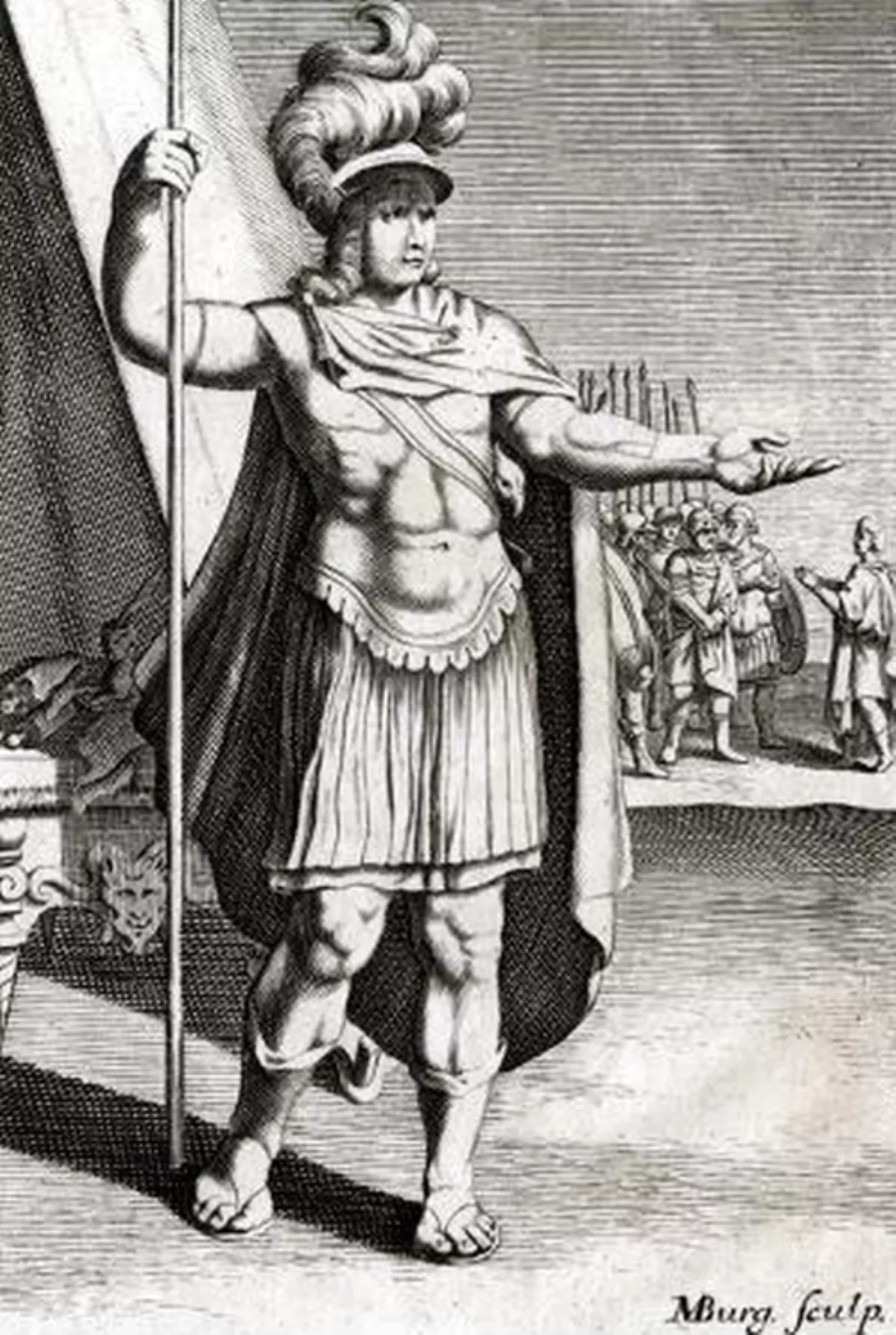
 1.
1. Eumenes participated in the Wars of Alexander the Great, serving as Alexander's personal secretary and later on as a battlefield commander.
 1.
1. Eumenes participated in the Wars of Alexander the Great, serving as Alexander's personal secretary and later on as a battlefield commander.
Eumenes depicted himself as a lifelong loyalist of Alexander's dynasty and championed the cause of the Macedonian Argead royal house.
Eumenes escaped and then allied with Polyperchon and Olympias, Alexander's mother, against Cassander and Antigonus.
Eumenes was a native of Cardia in the Thracian Chersonese.
Eumenes impressed Alexander's mother, Olympias, who later called him "the most faithful of my friends".
Eumenes served as hetairos and royal secretary under both Philip and Philip's successor, Alexander the Great.
Eumenes did not get along with Hephaestion, Alexander's closest companion, repeatedly arguing with him over "trivial matters".
Plutarch reports an anecdote of Eumenes hiding money from Alexander.
Eumenes wed Artonis, daughter of Persian satrap Artabazus II and sister of Pharnabazus III, Persian satrap of Phrygia.
Eumenes is recorded as an author of the Ephemerides, a chronicle of Alexander the Great's activities leading up to his illness and death.
Eumenes used his Cardian heritage to argue he had no personal motivation in the "Macedonian" struggle.
Perdiccas became regent, effective ruler of the vast Asian section of Alexander's Empire, and Eumenes served as his advisor.
Eumenes procured Alexander's "Last Plans" and gave them to Perdiccas, who read them out before the soldiers before rejecting them.
Eumenes thus had to subdue these forces to actually attain his satrapy.
Perdiccas used his authority as regent of the joint kings to order Leonnatus, satrap of Hellespontine Phrygia, and Antigonus, satrap of Phrygia, Pamphylia and Lycia, to aid Eumenes in securing his satrapy.
Eumenes was probably given 5000 talents of gold from Perdiccas for the reconquest of Cappadocia.
Leonnatus attempted to induce Eumenes to reconcile with Hecataeus and accompany him to Macedon to share in his far-reaching designs.
Eumenes refused, fearing Antipater would murder him if he returned, and felt "[unwilling] to abandon his standing with Perdiccas for a mad and dangerous dash to Macedonia".
Eumenes joined Perdiccas, who installed him in Cappadocia by defeating and killing Ariarathes in the summer of 322.
Eumenes reorganized his satrapy and appointed his supporters to prominent positions.
Eumenes then returned to Cappadocia to aid Neoptolemus in his efforts to subdue the Satrapy of Armenia.
Eumenes' advice carried weight as the common soldiers respected him after his pacifying of Armenia.
Eumenes, in turn, was given supreme command in Asia Minor to beat back Antipater and Craterus who were mustering armies in Greece.
Eumenes narrowly escaped capture in Sardis thanks to Cleopatra's warning.
Eumenes then retreated inland as Cleitus the White defected with his fleet, and Perdiccas, hearing of these disasters, ordered Neoptolemus and Alcetas to obey him.
Eumenes received messages from Craterus and Antipater once they had reached Asia Minor, promising to retain him in his satrapy if he joined them.
Eumenes then discovered Neoptolemus was planning to defect to Craterus and Antipater, and defeated him in battle in Phrygia, recruiting much of his army.
Eumenes proclaimed he had received a dream that his army would be victorious.
Eumenes, leading the left flank, killed Neoptolemus in single combat, then induced the enemy infantry to surrender, winning a "stunning victory".
Eumenes was now in "far worse circumstances than he had been at Alexander's death" as he was an outlaw and being actively hunted, but he had an experienced, loyal army and prepared for the coming conflict with Antigonus.
Eumenes was given the privilege of granting purple hats and cloaks to his soldiers, an honour usually only allowed for a Macedonian king.
Eumenes further consolidated loyalty by arguing to his men that the joint kings had been taken by traitors to the Macedonian throne and that, in effect, he and his army were still loyalists to the Argead house.
Eumenes first travelled to Mount Ida where there was a royal stable, and took a large number of horses to replenish his Cappadocian cavalry.
Eumenes took the time to file an account with the overseers of the stables despite his outlaw status.
Eumenes "continued to demonstrate his prowess as a military commander," attacking Hellespontine Phrygia and Phrygia itself while Antigonus and Antipater were present.
Since he would be facing a force superior in infantry, Eumenes decided to position himself in the plains of Sardis of Lydia where his advantage in cavalry would be decisive.
Eumenes had hoped to win the support of Cleopatra of Macedon, who was present in Sardis at the time.
Cleopatra and Eumenes had been friends since childhood Cleopatra was not willing to back what seemed to be a losing cause and implored Eumenes to leave the area lest she incur the wrath of Antipater.
Eumenes obliged her and moved north into Phrygia to winter.
Eumenes' plundering campaigns during this time were very successful, so much so that Antipater's soldiers began to become disgruntled.
Eumenes dealt with a defection of 3500 of his men this winter; he executed the leaders and pardoned the soldiers.
Eumenes was easily defeated due to the mid-battle desertion of a mercenary cavalry officer named Apollonides, who Antigonus had bribed.
Eumenes was put to flight having lost some 8000 men, and moved toward Armenia.
The remainder of the campaign turned into a battle of manoeuvre, with Eumenes avoiding further battle with Antigonus.
At one point, Eumenes was in a position to capture the baggage of Antigonus' forces.
Eumenes knew that he would not be able to prevent his soldiers from plundering this loot if they found out about it and that doing so would decrease the essential mobility of his forces.
Eumenes dispatched a private message to his old friend, the general Menander, advising him to move the baggage uphill so that its capture would be impossible.
Menander and the other Antigonid officers were shocked by Eumenes' warning; only Antigonus knew of his actual motives.
Eumenes was pursued by Antigonus for several weeks until the following winter.
Eumenes used guerrilla warfare to hold off Antigonus, but his men were deserting him.
Eumenes required Antigonus to send hostages to Nora before he was willing to come out and negotiate.
Eumenes kept the morale of his besieged men high by mingling with them regularly, aided, apparently, by his friendly appearance.
Eumenes effectively held out for more than a year until the death of Antipater threw his opponents into disarray.
Eumenes had taken them to Macedonia, but after his death left the regency to his friend Polyperchon instead of his son Cassander.
Polyperchon, in order to shore up his allies in the coming conflict with Cassander, had written to Olympias requesting help; Olympias, already in contact with Eumenes, now wrote to him for advice.
Eumenes told her to wait and see what would happen.
Eumenes decided to accept Polyperchon's offer, either out of a wish to protect the Argead royalty and Olympias, because of his own ambition and disinclination to be subordinate to another, or a combination of both factors.
Eumenes' acceptance meant the war in Asia with Antigonus would start .
Eumenes was able to secure control over the unruly commanders of the Silver Shields by playing on their undying loyalty to, and superstitious awe of, Alexander.
Eumenes claimed that Alexander had visited him in a dream and told him that he would be present with them at every battle.
Eumenes even went so far as to set up a tent for the late conqueror complete with a throne, diadem, and scepter.
Furthermore, Eumenes argued that as a Greek, a Cardian, "his only concern was the defence of the royal family".
Eumenes used the royal treasury at Cyinda to recruit an army of mercenaries to add to his own troops, a process that took several months but built up a sizeable army.
Eumenes emerged from Antigonus' propaganda campaign with a generally greater authority among his Macedonian troops.
Seleucus and Peithon attempted to subvert the Silver Shields while Eumenes was in Babylonia, and when they failed flooded his camp.
Eumenes drained the land and escaped, and Seleucus, unable to oppose him, signed a truce for his passage.
In Susiana, Eumenes joined the already assembled army of the upper satraps.
Eumenes crossed the Pasitigris, where he planned to ambush Antigonus, knowing he would be crossing blind.
Eumenes required more troops to block the entire river, and so asked Peucestas to recruit more; Peucestas initially refused to do so, resenting Eumenes, but eventually agreed.
Eumenes sent an advance force ahead in boats to ensure a beachhead on the opposite side of the river.
Eumenes, who had camped nearby and placed scouts across the breadth of the river to alert him, soon heard that Antigonus had sent over men and quickly rode over with an army.
Eumenes waited until the army was mid-crossing, and then surprised Antigonus' soldiers, easily routing them, capturing 4000 men while killing some 6000 others.
The forged letter was believed because Eumenes had composed it in Aramaic, the common language of the Persian Empire, and Orontes was a friend of Peucestas.
Eumenes then acted against Peucestas' allies, summoning the satrap of Arachosia Sibyrtius to a show trial after seizing his baggage train, making him flee.
Eumenes wanted to battle Antigonus while his army had high morale, but while entertaining his troops became sick.
Eumenes slightly recovered, but was compelled to give over supreme command to Peucestas and Antigenes to lead the army north while Eumenes himself convalesced, being carried in a litter.
Eumenes recovered and when the armies were within a day or so of each other resumed overall command to meet Antigonus.
Antigonus, on the fifth day, again attempted to subvert the Silver Shields, who again refused; Eumenes praised them for their loyalty.
Eumenes then learned from deserters that Antigonus was planning to break camp and move away, and guessed Antigonus wanted to relocate to the region of Gabiene.
Eumenes positioned his elite troops on his right flank, including the Silver Shields, and led the elite cavalry himself.
Eumenes placed his war elephants and light infantry in a screen ahead of his heavy infantry.
The formation was defensive as Eumenes did not want to attack Antigonus uphill.
Eumenes returned to the battlefield and buried his own dead lavishly.
Eumenes then settled into Gabiene while Antigonus, indecisively defeated, reached and rested in Media.
Eumenes had stationed sentries on the roads, but not along the freezing desert routes into Gabiene.
Eumenes successfully persuaded the satraps to remain by pointing out their troops would be well-rested while Antigonus' would be tired from traversing the desert, and told them of a plan which would give them enough time to assemble the whole army.
Eudamus learned of the conspiracy and warned Eumenes, who thought of fleeing but chose not to.
Eumenes destroyed his correspondence, wrote his will, and prepared for the coming battle.
Again, Eumenes screened his cavalry with elephants and light infantry skirmishers.
Eumenes' strategy focused on his phalanx and the Silver Shields; he ordered Philip, one of his loyal supporters, not to engage the enemy.
Eumenes had placed Peucestas and the other satrapal cavalry on his own flank, perhaps to ensure they followed his orders.
Eumenes' left cavalry was defeated due to the sudden retreat of Peucestas and the satrapal horsemen, which led to panic and another 1500 cavalry retreating with him.
Eumenes continued to struggle against Antigonus, leading his cavalry forward in a charge in an attempt to meet and kill Antigonus in single combat, but failing due to his inferior number of horsemen.
Eumenes, noting that the enemy phalanx had been destroyed, attempted to regather his cavalry on the right flank for a final push.
Eumenes had heard his baggage had been captured, but believed that if his united cavalry joined the Silver Shields a renewed offensive would not only reclaim the lost baggage, but rout Antigonus' army and claim their baggage as well.
Peucestas and the satraps refused Eumenes' orders, withdrawing further away as night approached.
Eumenes was now in a precarious position, as he had planned for victory or defeat, but not stalemate.
Eumenes arrived at camp following the battle after the Silver Shields and satraps did, and a conference was held in the late evening.
The satraps wished to retreat, but Eumenes wanted to battle again the next day, citing the fact that the cavalry were not greatly diminished and the Silver Shields' victory in the centre.
Eumenes was given to Antigonus, who placed him under guard and held councils to decide his fate that lasted several days.
Eumenes' body was given to his friends to be burnt with honour, and his ashes were conveyed in a silver urn to his wife and children.
Eumenes is broadly seen as an excellent commander, skilled in both tactics and strategy and Antigonus' only military equal, who did his utmost to maintain the unity of Alexander's empire in Asia.
Eumenes was an "adept propagandist", who used diplomacy and ruse to his advantage wherever possible.
Eumenes' efforts were repeatedly frustrated by issues of divided command and disloyal subordinates: his "most serious problem" which were handicaps many of his enemies, notably Antigonus, did not have to struggle with.
Anson considers it "remarkable" that Eumenes came so close to defeating Antigonus, ultimately only losing through betrayal, given Antigonus' notable skill as a general and the repeated issues Eumenes dealt with.
Eumenes' defeat is seen as spelling the end for the Argead loyalists and, effectively, the Argead monarchy, leaving Alexander's Empire "in the hands of men who owed no loyalty except to themselves".
Romm writes that Eumenes "was the last general in the field with the ability, and will, to defend [the Argeads]", and that "through sheer talent Eumenes had risen through the ranks; despite his Greek origins, he had come desperately close to gaining supreme power".