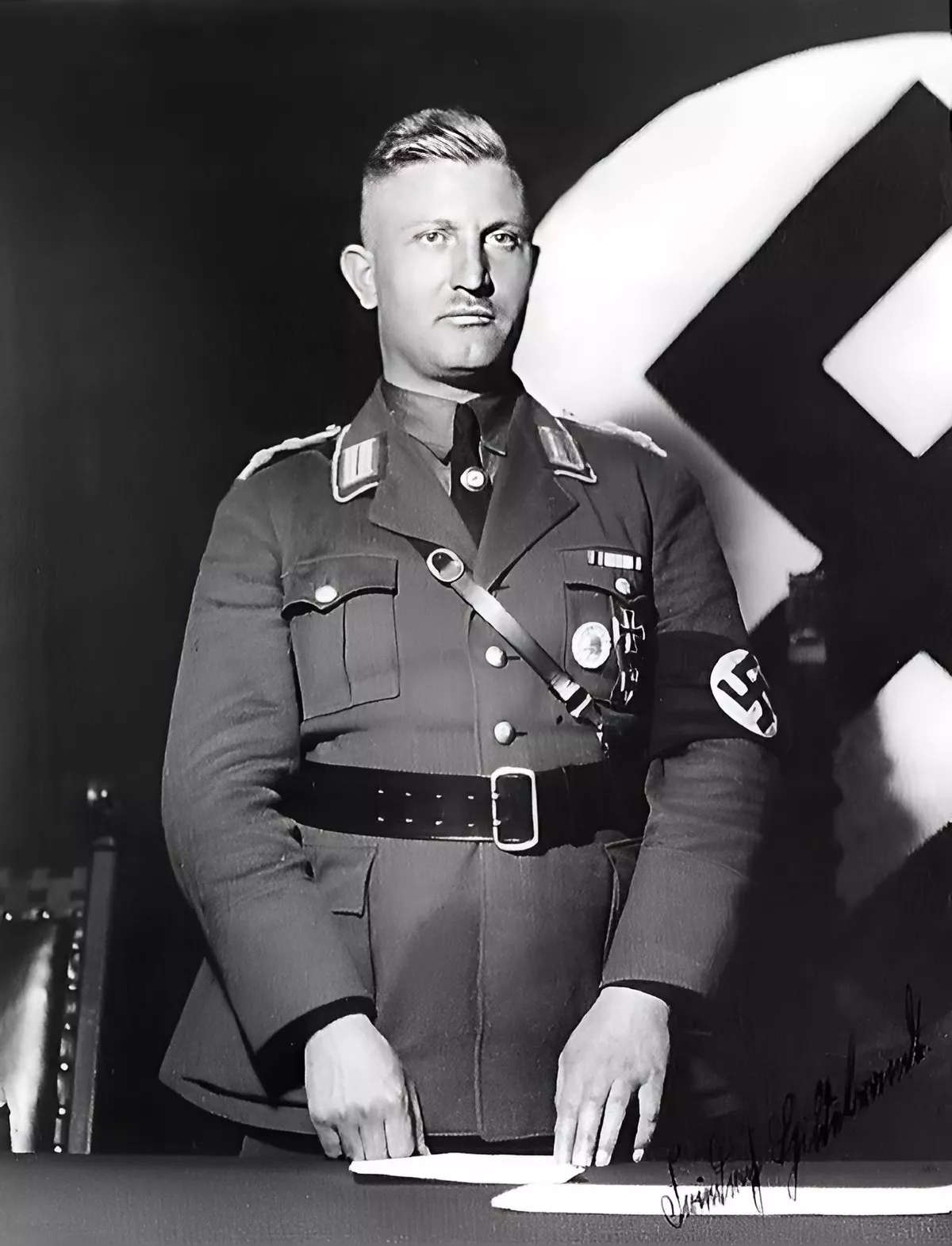
 1.
1. Friedrich Hildebrandt was a Nazi Party politician, a Gauleiter and an SS-Obergruppenfuhrer.
 1.
1. Friedrich Hildebrandt was a Nazi Party politician, a Gauleiter and an SS-Obergruppenfuhrer.
Friedrich Hildebrandt was found guilty and executed for war crimes committed during the Second World War.
Friedrich Hildebrandt attended volksschule until 1913 and then found employment as an agricultural worker and a railway employee.
Friedrich Hildebrandt was severely gassed in Flanders in 1917 and wounded twice again before the end of the war, for which he earned the Wound Badge in silver and the Iron Cross, first and second class.
Friedrich Hildebrandt was later repatriated to Germany, being discharged from the German Army as a Vizefeldwebel in January, 1920.
In March 1920, Friedrich Hildebrandt joined the security police in Halle and participated in the suppression of the Kapp-Putsch.
Friedrich Hildebrandt then found employment as a farm worker and gardener.
Friedrich Hildebrandt joined the Nazi Party in February 1925 when it was refounded and, as an early member, he later was awarded the Golden Party Badge.
In 1927, Friedrich Hildebrandt became the founder and editor of a Nazi newspaper, the Niederdeutscher Beobachter, later serving as editor of two additional such publications, the Lubecker Beobachter and the Strelitzer Beobachter.
Briefly suspended as Gauleiter by Rudolf Hess in July 1930 for criticism of Adolf Hitler's alliance with industry, Friedrich Hildebrandt was reinstated on 31 January 1931 after making a declaration of loyalty to Hitler.
Friedrich Hildebrandt was elected to the Reichstag in September 1930 as a deputy for electoral constituency 35 and served there until the fall of the Nazi regime.
Friedrich Hildebrandt was elevated to the new post of Reichsstatthalter of Mecklenburg-Schwerin, Mecklenburg-Strelitz and the Free City of Lubeck on 26 May 1933.
Friedrich Hildebrandt thus united under his control the highest party and governmental offices in his jurisdictions.
From 1933 to 1934, Friedrich Hildebrandt served as the leader of the Nordische Gesellschaft, which sought to strengthen German-Nordic cultural and political cooperation.
Friedrich Hildebrandt was made a member of Hans Frank's Academy for German Law in 1935.
On 1 April 1937, the Greater Hamburg Act transferred the City of Lubeck to Gau Schleswig-Holstein and Friedrich Hildebrandt's Gau was renamed Gau Mecklenburg.
Friedrich Hildebrandt became a member of the SS on 5 December 1933 with the rank of SS-Oberfuhrer.
Friedrich Hildebrandt was made the honorary commander of SS-Standarte 22, headquartered in Schwerin, and was promoted to SS-Gruppenfuhrer on 27 January 1934.
Friedrich Hildebrandt was assigned to the staff of the Reichsfuhrer-SS on 23 January 1936.
Friedrich Hildebrandt was named Reich Defense Commissioner for his Gau on 16 November 1942 and, on 25 September 1944, he was made commander of the Volkssturm in his Gau.
Six of those convicted, including Friedrich Hildebrandt, were sentenced to death by hanging.