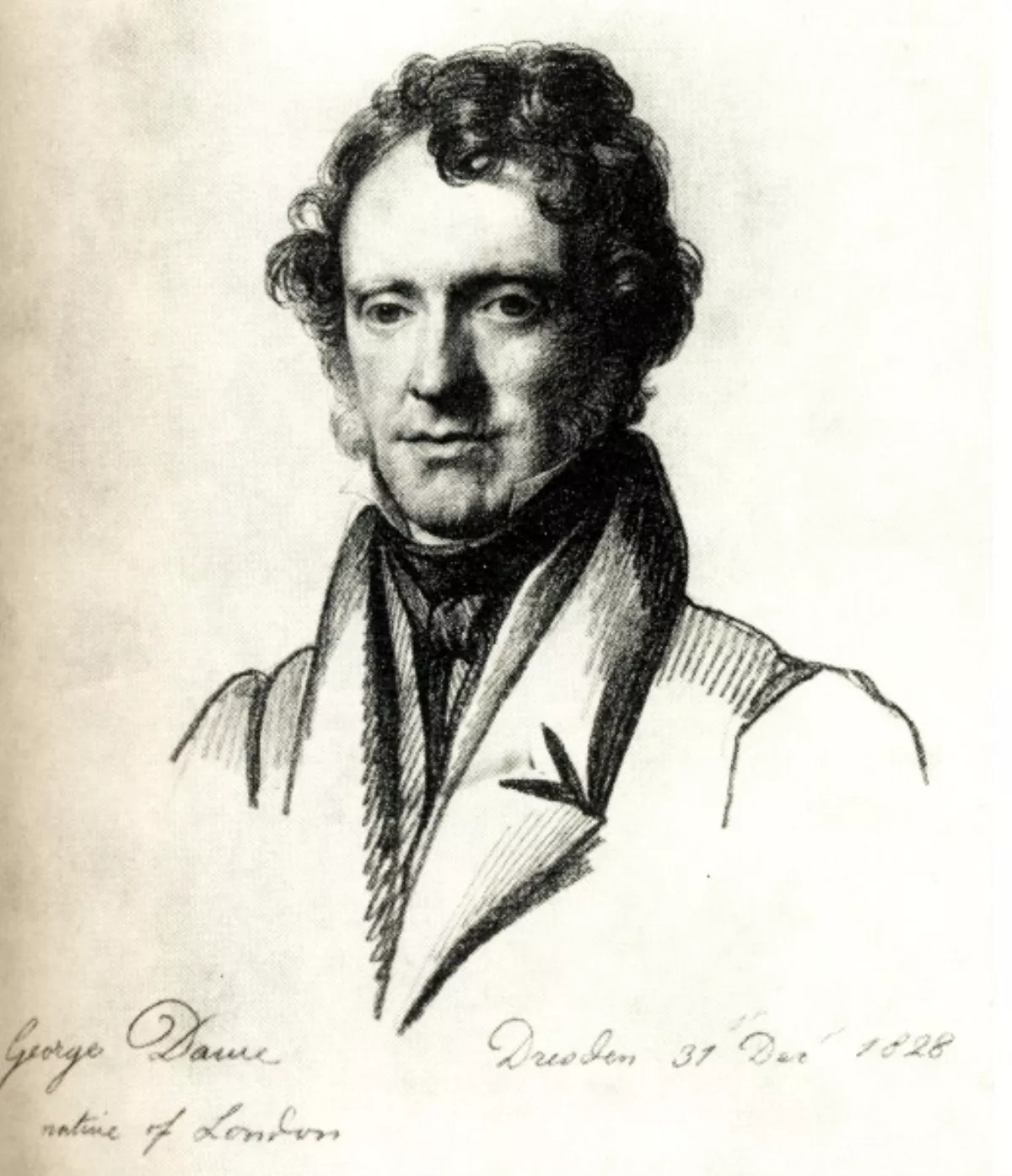
 1.
1. George Dawe was an English portraitist who painted 329 portraits of Russian generals active during Napoleon's invasion of Russia for the Military Gallery of the Winter Palace.
 1.
1. George Dawe was an English portraitist who painted 329 portraits of Russian generals active during Napoleon's invasion of Russia for the Military Gallery of the Winter Palace.
George Dawe relocated to Saint Petersburg in 1819, where he won acclaim for his work from the artistic establishment and complimentary verses by Pushkin.
George Dawe was the son of Philip Dawe, a successful mezzotint engraver who produced political cartoons relating to the events of the Boston Tea Party.
George Dawe died on 15 October 1829 in Kentish Town, United Kingdom.
George Dawe was the first child born to the couple and there would be other successful artists in the family.
George Dawe originally trained with his father as an engraver and became very accomplished from an early age.
George Dawe later became interested in painting and went on to study at the Royal Academy of Arts where he won the Royal Academy Schools Gold Medal in 1803.
George Dawe was elected an associate member of the Royal Academy in 1809 and became an Academician in 1814.
George Dawe collected old masters and studied modern and classical languages, philosophy and literature.
George Dawe studied anatomy as part of his pursuit of a better understanding of the human form and undertook human dissections in his own home as well as attending operations to improve his knowledge of the human body.
George Dawe's painting of classical subjects won much praise and were the making of his early reputation but he was more interested in financial success and sought portraiture commissions which were lucrative and which brought him into contact with high society.
George Dawe enjoyed the patronage of the Duke and Duchess of Kent and that of Princess Charlotte and Prince Leopold.
George Dawe went to live in St Petersburg and, from 1822 to 1828, painted over 300 portraits for the military collection at the Winter Palace with his assistants, Alexander Polyakov and Wilhelm August Golicke.
George Dawe became a celebrity throughout Europe and mixed with the Russian intellectual elite.
George Dawe returned to England in 1828 and stayed for several months.
George Dawe returned to St Petersburg in 1829 but soon became increasingly unwell with breathing difficulties following a serious cold.
George Dawe had pulmonary weakness throughout life following childhood illness.
George Dawe returned to London in August 1829 and died on 15 October at the home of his brother-in-law, Thomas Wright, a celebrated engraver.
George Dawe was buried in the crypt of St Paul's Cathedral and his funeral was attended by many artists and officials from the Russian embassy.