 1.
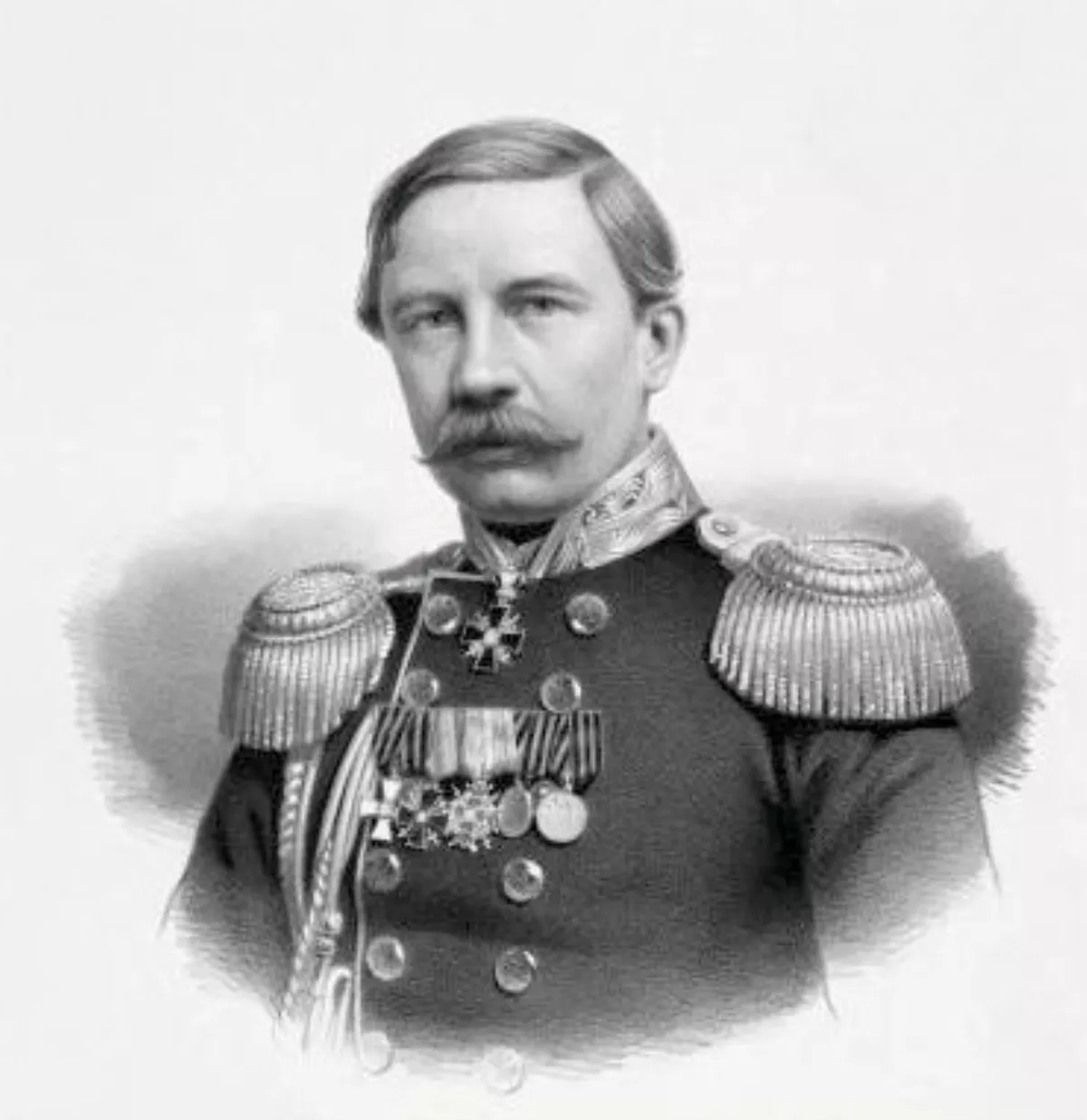
1. Grigory Ivanovich Butakov was a Russian admiral who fought in the Crimean War.
 1.
1. Grigory Ivanovich Butakov was a Russian admiral who fought in the Crimean War.
Grigory Butakov was involved in the first battles of the Crimean War, which includes the first sea battles involving steam-powered ships.
Grigory Butakov wrote of his experiences in his book: New Principles of Steamboat Tactics, which won him the Demidov Prize.
In 1881 Grigory Butakov assumed the role of Commander-in-Chief of the Port of St Petersburg.
Grigory Butakov was made a member of the State Council in March 1882.
Shortly after gaining both titles however, Grigory Butakov fell seriously ill, and died on 31 May 1882, aged 62.
The minor planet 4936 Grigory Butakov was named in his memory.
Grigory Ivanovich Butakov was born 9 October 1820 in Riga; a large city in the Russian Empire.
Grigory Butakov's father was a distinguished naval officer who fought in the Russo-Turkish War of 1806.
Grigory Butakov captained the battleship Tsar Constantine, in which he commanded during several naval operations around Crete and in the Blockade of the Dardanelles.
Grigory Butakov was inspired by his father's success as a naval officer, so in May 1831 at eleven years old, Grigory Butakov decided to join a Naval Academy in St Petersburg.
Grigory Butakov graduated in 1837 and was immediately assigned to serve as a flag officer aboard the Russian vessel Silistria.
In May 1838, Grigory Butakov took part in a landing operation near Abkhazia against Turkish positions.
Grigory Butakov was awarded several decorations for bravery during the operation.
From September 1838 to August 1840, Grigory Butakov patrolled the Aegean Sea aboard the schooner Lastochka, and in 1844, he patrolled the Mediterranean Sea aboard the Vestnik.
Not long after his promotion, Grigory Butakov became interested in improvements to the Navy in the field of Naval Science.
Grigory Butakov developed a completely new system of fog signals, and invented a new version of windlass.
On 3 December 1852, Lieutenant-Commander Grigory Butakov was made captain of the steam-ship Vladimir, considered the best steam-powered warship in the Black Sea Fleet.
Grigory Butakov sailed the Vladimir towards the region of Penderakli, on the way the crew of the Vladimir saw an unfamiliar vessel sailing towards them.
Once the Ottoman ship was in range, Grigory Butakov maneuvered the Vladimir into advantageous positions for an attack.
Grigory Butakov then gave an order to pick up speed, and at a distance of 100 meters, he opened canister fire from all ship's the guns.
Grigory Butakov's commanding officers thought very highly of him, particularly after the victory over the Pervas Bahri.
Grigory Butakov provided substantial cannon support during the siege by sailing into favorable positions and bombarding the British, French and Ottoman fortifications, which surrounded the port.
Grigory Butakov volunteered to leave the Vladimir, and fight as an infantryman.
Grigory Butakov sailed the Vladimir so close to the shore that he actually made his ship inaccessible to the French battery, while maintaining a clear line of sight of the enemy cannons, he then ordered his ships to fire upon the French battery, causing major damage.
Grigory Butakov was appointed High Chief of the naval unit in Nikolayev and the Naval Governor of Nikolayev and Sevastopol.
In early 1854, Grigory Butakov compiled descriptions of "evolutions" in steam warship design, such advantageous turns and maneuvering of the ships in line that would be necessary for taking up the most advantageous position during battle.
Grigory Butakov found solutions to some tactical problems, drew up illustrative tables of courses and movements of ships in the fleet, and outlined three basic detachment formations.
Grigory Butakov would compile his ideas in his book; New Principles of Steamboat Tactics.
Grigory Butakov was transferred to the Baltic Fleet in 1860.
In 1863, Grigory Butakov compiled all of his notes on tactical strategies of steamboats, and wrote about them in a book called: New principles of Steamboat Tactics.
On 28 October 1866, Grigory Butakov was promoted to the rank of vice admiral.
Whilst serving in the Baltic Fleet, Grigory Butakov paid much attention to artillery preparation of his squadron, he knew that although the Russian navy excelled in steamboat warfare, the cannons aboard the ships were seriously outdated.
Grigory Butakov knew that recent advancements in the form of 'Ironclad' ship armor, would mean that cannons had to be improved in order to penetrate the armor.
Grigory Butakov developed a system which included; first, firing from one ship at a fixed shield, then at a towed one, and finally, firing at a moving target.
Grigory Butakov believed that boat racing was not only a good pastime for sailors, it was good for their training and military skill.
Grigory Butakov was so passionate about boat racing, he secured annual allocations of 1500 rubles in prize money for young sailors in boat racing competitions.
Grigory Butakov published a book on the subject called Rules of Boat Race.
From 1867 to 1877, Grigory Butakov served aboard an Armoured Ship Squadron in the service of the Baltic Fleet.
On 16 October 1878, Grigory Butakov was promoted from Vice-Admiral to Admiral, and was appointed Chief Commander of the Sveaborg coastal fortifications.
In March 1882, Grigory Butakov was elected a member of the National State Council: He took this assignment at the end of his life's work.
Grigory Butakov was widely mourned throughout Russia and he was buried in the Nikolskoe Cemetery of the Alexander Nevsky Lavra, Saint Petersburg.