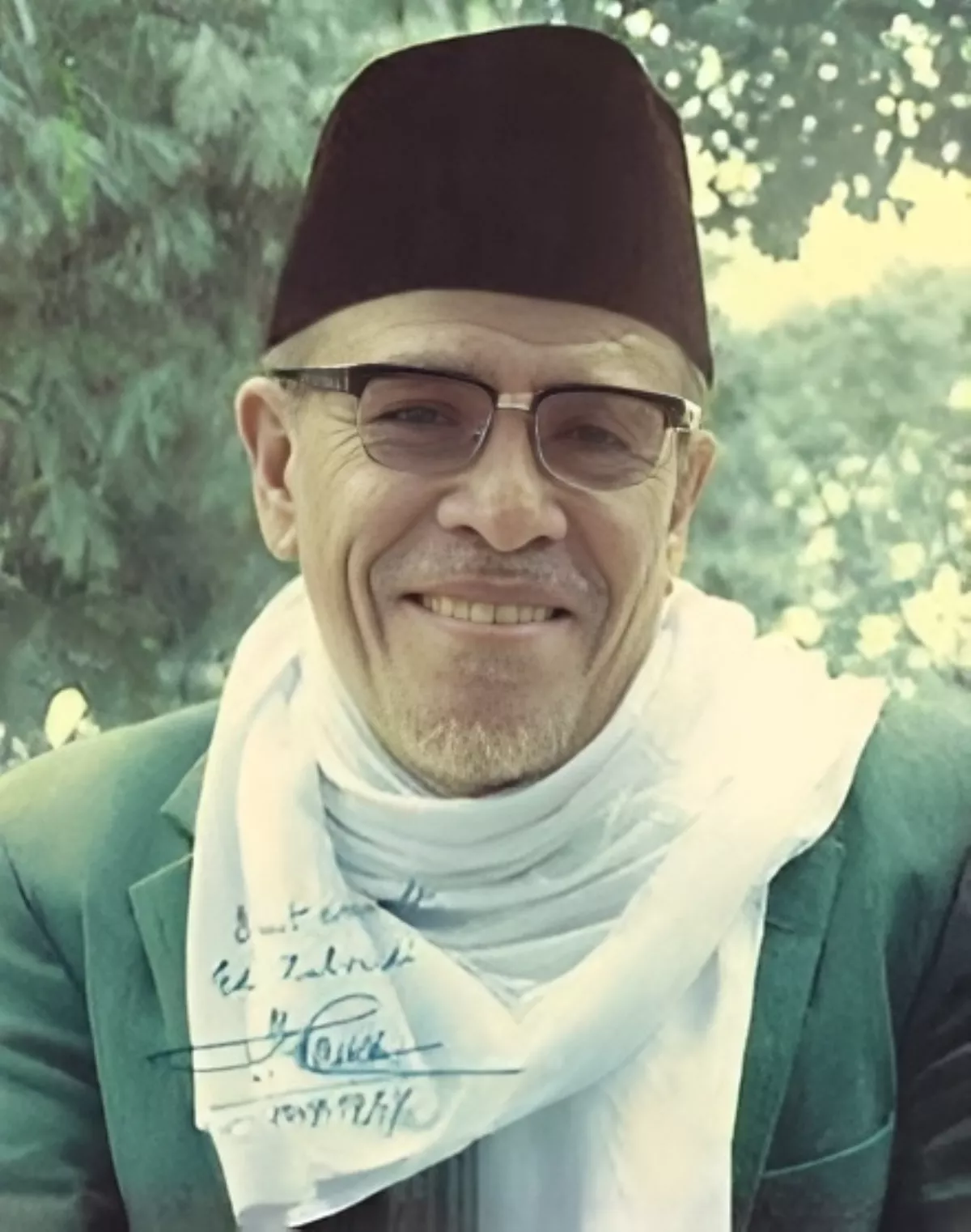
 1.
1. Hamka served as the inaugural chief cleric of the Indonesian Ulema Council, and was active in Muhammadiyah until he died.
 1.
1. Hamka served as the inaugural chief cleric of the Indonesian Ulema Council, and was active in Muhammadiyah until he died.
Hamka is further honoured by being the namesake of Hamka Muhammadiyah University in Jakarta, and is named an Indonesian National Hero.
Hamka was born on 17 February 1908 in Agam, West Sumatra, the eldest of four siblings.
Hamka's paternal grandfather, Muhammad Amrullah, was a member of the Naqshbandiyah.
Hamka had a younger brother, Abdul Wadud Karim Amrullah, whose child is the American drag performer and winner of the third season of RuPaul's Drag Race, Raja Gemini.
The first few days after his parents divorced, Hamka did not go to school.
Hamka read literary works published by Balai Pustaka, Chinese stories, and Arabic translations.
In Parabek, young Hamka learnt to fulfill his daily needs as a santri.
Hamka travelled all over Minangkabau as a teenager, gaining the nickname Si Bujang Jauh, from his father.
Hamka decided to leave for Java at the age of 15, when he learnt that the Islam taught there was far more advanced in terms of structure and organisation.
Hamka ran away from home, unnoticed by his father and only said goodbye to his grandmother in Maninjau.
Hamka tried to continue but was forced to go back to Meninjau where he spent two-months bedridden.
Hamka departed to Java again in July 1924, after spending two months bedridden.
In Pekalongan, Hamka met his father who failed to leave for Egypt after the postponement of the International Caliphate Congress.
Hamka saw no difference between Islamic reformation missions in both the Minangkabau and Javan regions: the reformation in Minangkabau aimed at purifying Islam off regressive practices of imitation and superstition, while the Javan movement was more focused to the efforts of combating "backwardness", ignorance and poverty.
Hamka left without saying goodbye to his father, using his own money he departed from Belawan Harbor for Jeddah.
Hamka soon returned home after seven months of living in Mecca.
However, instead of going back to Padang Panjang, Hamka settled in the city of Medan, where his returning ship had anchored.
Hamka sent his writings to the newspaper Pembela Islam in Bandung and Voice of Muhammadiyah, which was led by Abdul Rozak Fachruddin, in Yogyakarta.
Hamka was a member of a makeshift assembly that handled government and Islamic matters in 1944.
Hamka accepted this position believing the Japanese promise to grant independence to Indonesia.
Hamka was subjected to endless criticism as the Japanese were defeated and surrendered to the Allies, which drove him back to the Minangkabau after the Indonesian Revolution broke out in 1945, joining Indonesian guerrillas to fight against the return of the Dutch in the jungles of Medan.
Hamka later appointed Muhammad Rasami as secretary of the Muhammadiyah Bengkalis Branch Management.
Hamka had an increasingly uphill career when he moved to Medan.
In 1942, along with the fall of the Dutch East Indies to the Japanese Empire, Hamka was elected as leader of East Sumatra's Muhammadiyah branch to replace H Mohammad Said.
In 1962, as senior member of the Masyumi Party which was disbanded due to connection to PRRI rebellion, Hamka was jailed two years because he refused to condemn his party members' involvement in the rebellion against the state that was supported by a number of Masyumi leaders.
Hamka's health started to decline after his resignation as chairman of MUI.
Hamka died on Friday, 24 July 1981 at 10:37 WIB at the age of 73 years.
Hamka's body was buried at his home on Jalan Raden Fatah III.
Hamka's body was taken to the Al-Azhar Grand Mosque and prayed for again, before being buried in the Tanah Kusir Public Cemetery, South Jakarta, led by the Minister of Religion Alamsyah Ratu Perwiranegara.
In 2016, the Indonesian Ulema Council started production on a movie about Hamka's life, titled Buya Hamka.