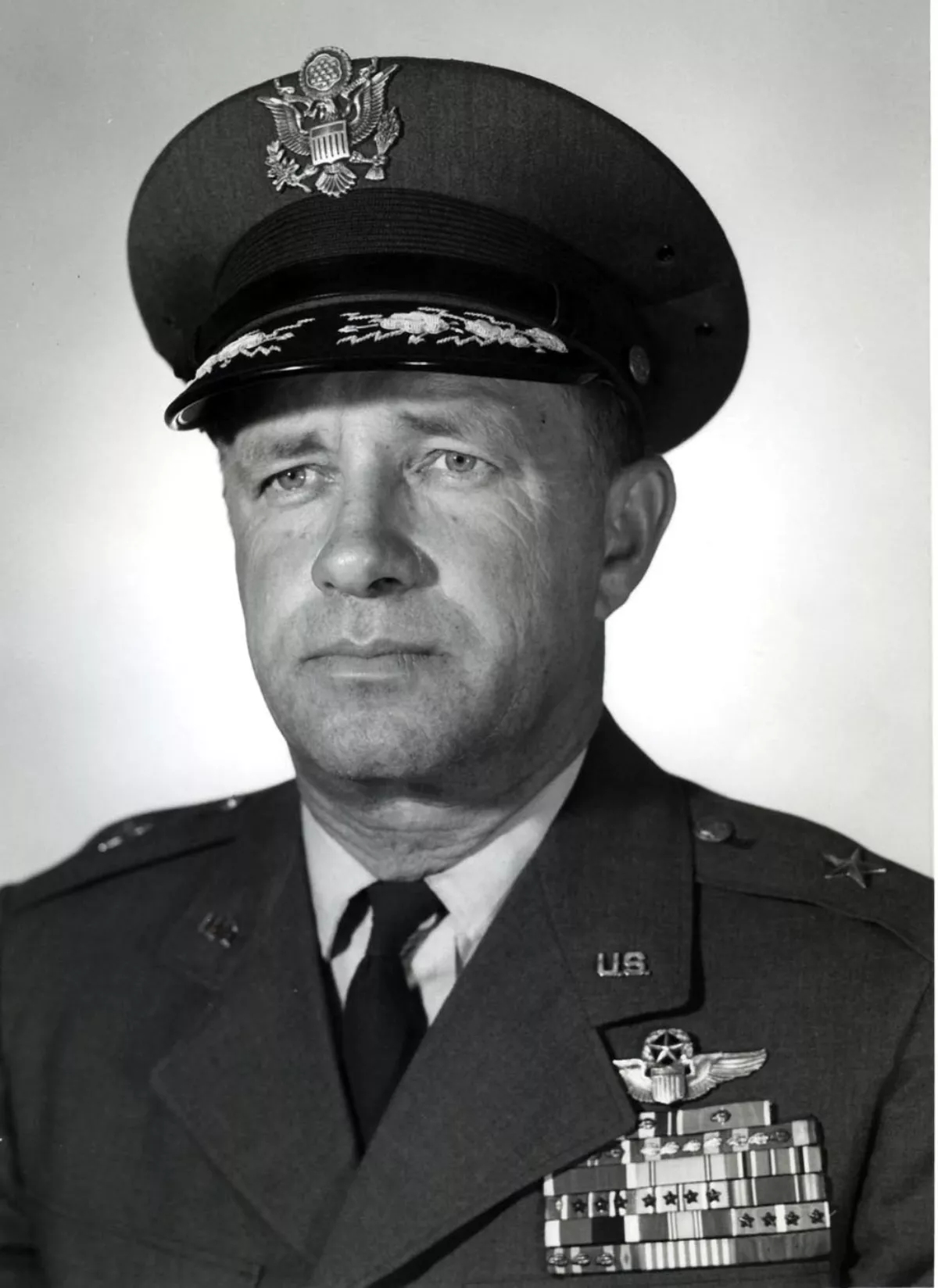
 1.
1. Brigadier General Harrison Reed Thyng was a fighter pilot and a general in the United States Air Force.
 1.
1. Brigadier General Harrison Reed Thyng was a fighter pilot and a general in the United States Air Force.
Harrison Thyng is notable as one of only six USAF fighter pilots to be recognized as an ace in two wars.
On retiring from the military, Thyng became a New Hampshire candidate to the United States Senate.
Harrison Thyng was educated in a rural school system, attending a "one-room" school through the 8th Grade, then attending Pittsfield High School.
Harrison Thyng was an avid athlete, participating in football, baseball and track, in all of which he lettered, and graduated in 1935.
Harrison Thyng obtained a Bachelor of Arts pre-law degree from the University of New Hampshire in 1939.
Harrison Thyng trained at Parks Air College near East St Louis, Illinois, for primary, Randolph Field for basic, and Kelly Field for advanced, where he obtained his wings and commission in the Air Corps on March 23,1940.
Harrison Thyng became the first commanding officer of the newly created 309th Fighter Squadron, 31st Fighter Group.
Harrison Thyng was granted a "probable" kill of an Fw 190 and was awarded the Silver Star for flying top cover for a rescue mission of a downed 31st FG pilot.
Harrison Thyng won a second Silver Star attacking German armored forces during the battle and was shot down twice, once by British anti-aircraft fire.
Harrison Thyng officially was credited with shooting down 4 Bf 109 fighters while commanding the 309th to be recognized as an ace on May 6,1943.
Harrison Thyng, promoted to lieutenant colonel in February, moved up to second-in-command of the 31st Fighter Group on May 12,1943, and continued operations until wounded in action.
Harrison Thyng officially was credited with 162 combat sorties and 5 planes destroyed.
Harrison Thyng was promoted to full colonel at the age of 26 and returned to the United States, where on November 1,1944, he was made commander of the 413th Fighter Group at Bluethenthal Field, North Carolina.
Harrison Thyng's group flew its sole B-29 escort mission on August 8,1945, to Yawata, Japan.
Harrison Thyng is credited with 22 sorties but despite some accounts asserting that he shot down one of the 16 Japanese aircraft credited to his group, he was not awarded any kills in this theater and the credit is likely based on submission of a "probable".
Harrison Thyng remained in command of the 413th FG until October 14,1945.
Harrison Thyng was granted a commission in the Regular Army in 1946 and in the United States Air Force on September 18,1947, when that service became an independent arm.
Harrison Thyng was named commander of the 33rd Fighter-Interceptor Group, flying North American F-86 Sabres from Otis Air Force Base, Massachusetts, and moved up to command its parent 33rd Fighter-Interceptor Wing in April 1951.
Harrison Thyng deployed to Kimpo Air Base, South Korea in October 1951 and while still on unassigned duty recorded his first MiG-15 kill on October 24,1951, flying with the 4th Fighter-Interceptor Wing.
Harrison Thyng was made commander of the wing on November 1,1951, at a period of time when United Nations air superiority over North Korea was being severely challenged by the communist forces.
Harrison Thyng, going over the heads of the chain of command, warned USAF Chief of Staff General Hoyt Vandenberg that "I can no longer be responsible for air superiority in northwest Korea" because of an inability to field sufficient numbers of F-86s to conduct combat operations.
Harrison Thyng recorded four additional MiG kills to become a jet ace on May 20,1952, and was awarded his third Silver Star.
Harrison Thyng cites RAF Air Marshal Sir John M Nicholls KCB CBE DFC AFC, then a flight lieutenant exchange pilot with the 4th FIW, as stating Thyng sent him low over the primary MiG base at Antung "to stir them up" and then shot down a reacting MiG-15 after it had taken off.
Charles G Cleveland, then a 1st lieutenant in the 335th FIS, as being in a flight led by Thyng that resulted in a shoot down north of Mukden, although the claim submission placed the location at the mouth of the Yalu River.
Harrison Thyng commanded the 4th FIW through October 2,1952, and flew 114 missions.
Harrison Thyng had a succession of assignments with the Air Defense Command and NORAD.
Harrison Thyng served as deputy of operations for the Western Air Defense Area, as vice commander and commander of an ADC Air Division, and after promotion to brigadier general in May 1963, as vice commander of NORAD North Region at CFB North Bay, Ontario.
Harrison Thyng saw duty in Headquarters USAF and with the Federal Aviation Agency.
Harrison Thyng observed the testing of air-to-air missiles in Southeast Asia and flew several combat sorties.
Harrison Thyng retired from the Air Force on April 1,1966, to go into politics.
Harrison Thyng had over 650 hours of combat flight time on 307 sorties in three wars, with 10 aircraft officially credited shot down and another 6 unofficially attributed to him.
Harrison Thyng had operational experience flying the P-40, P-39, Spitfire Vb, P-47N, F-80, F-84, F-86, F-89, F-94, F-100, F-102, and F-106 fighter aircraft.
In 1966 Thyng ran as the Republican Party candidate for the United States Senate seat from New Hampshire held by Thomas J McIntyre.
Harrison Thyng prevailed in a crowded Republican primary that included former governors Lane Dwinell and Wesley Powell, Party chair William R Johnson, and Doloris Bridges, widow of 25-year US Senator Styles Bridges.
Harrison Thyng founded the New England Aeronautical Institute in 1965, which later merged with Daniel Webster Junior College to become Daniel Webster College in Nashua, New Hampshire, and served as its first president.
Harrison Thyng died of heart attack on September 24,1983, at the age of 65.
Harrison Thyng was buried at Riverview Cemetery in Barnstead, New Hampshire.
On July 17,2004, a memorial to General Harrison Thyng was dedicated in Pittsfield by the Pittsfield Historical Society, with United States Senator Judd Gregg; General Ronald Fogleman, former Chief of Staff of the United States Air Force; Lt Gen Daniel James III, Director of the Air National Guard; and Maj Gen John Blair, New Hampshire National Guard, in attendance.