 1.
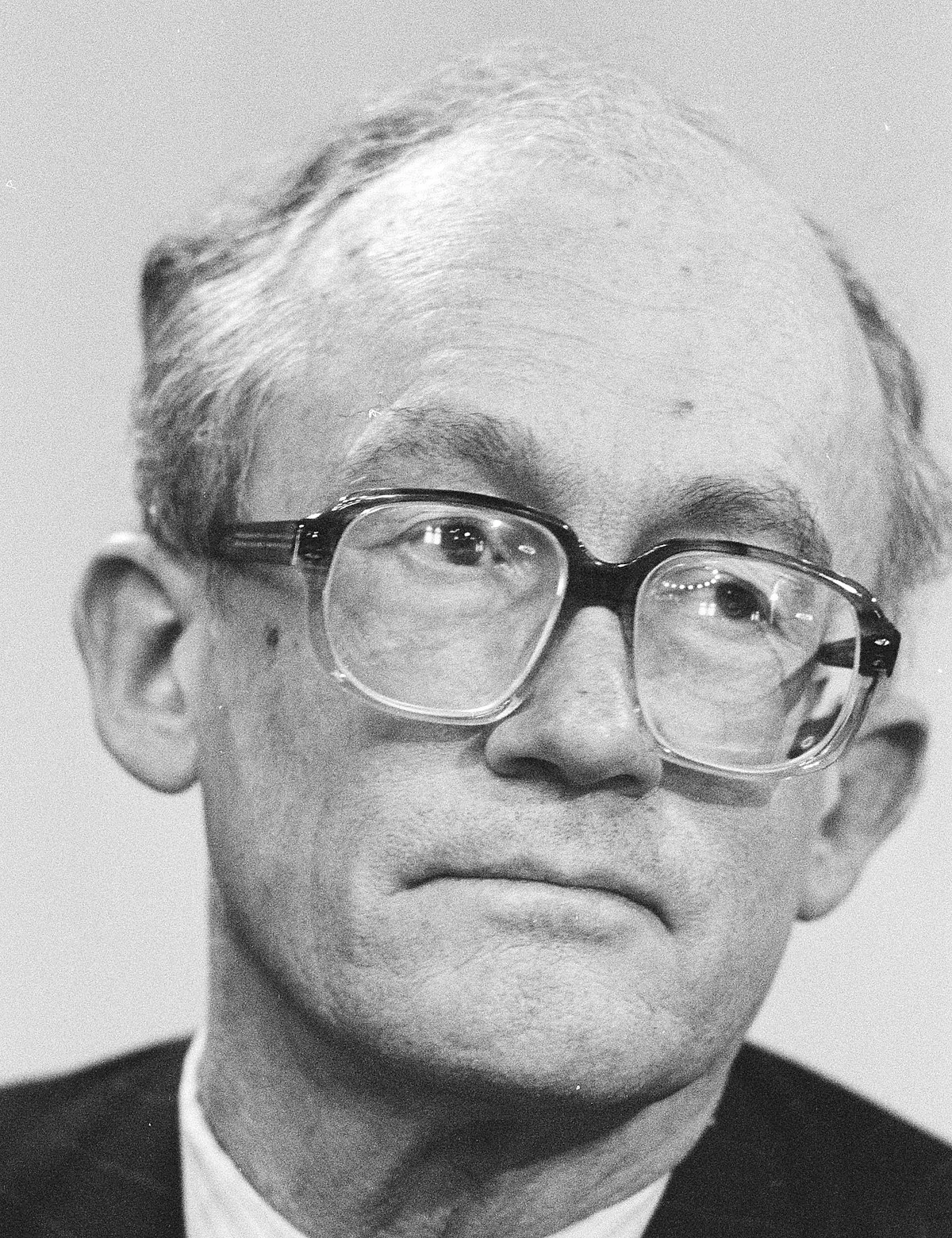
1. Hendrikus Johannes "Johan" Witteveen was a Dutch politician and economist who served as the fifth managing director of the International Monetary Fund from 1973 to 1978.
 1.
1. Hendrikus Johannes "Johan" Witteveen was a Dutch politician and economist who served as the fifth managing director of the International Monetary Fund from 1973 to 1978.
Johan Witteveen worked as a researcher for the Bureau for Economic Policy Analysis from April 1945 until July 1947 and as a professor of Financial economics at the Rotterdam School of Economics from July 1947 until 24 July 1963.
Johan Witteveen served as Rector Magnificus of the Erasmus University Rotterdam from 1 January 1951 until 1 January 1952.
Johan Witteveen became a Member of the Senate after the death of Anthonie Nicolaas Molenaar, taking office on 23 December 1958 serving as a frontbencher and spokesperson for Finances and deputy spokesperson for Economic Affairs and Small business.
Johan Witteveen was elected as a Member of the House of Representatives after the election of 1963, he subsequently resigned as a Member of the Senate the same day he was installed as Member of the House of Representatives, taking office on 5 June 1963.
Johan Witteveen returned as a distinguished professor of Public economics at the Rotterdam School of Economics on 1 September 1965.
Johan Witteveen subsequently returned as a Member of the House of Representatives after the resignation of Lambertus Oldenbanning, taking office on 21 September 1965 serving as a frontbencher chairing the parliamentary committee for Finances and spokesperson for Finances and deputy spokesperson for Economic Affairs.
Johan Witteveen served as acting Minister of Economic Affairs from 7 January 1970 until 14 January 1970 following Leo de Block's resignation.
In February 1971 Johan Witteveen announced that he wouldn't stand for the election of 1971 but wanted to return to the Senate.
Johan Witteveen was a prolific author, having written more than a dozen books since 1947 about Politics, Finances, Economics, Business and Sufism.
Johan Witteveen was known for his abilities as a manager and consensus builder.
Johan Witteveen continued to comment on political affairs as a statesman until his death at the age of 97 and holds the distinction as the only Dutchman that served as Managing Director of the International Monetary Fund.
Johan Witteveen's eldest son Willem was a politician, professor, and author, he like his father had served in the Senate.
Johan Witteveen was born on 12 June 1921 in Zeist in the province of Utrecht.
Johan Witteveen is the son of architect Willem Gerrit Witteveen and Anna Maria Wibaut and the grandson of Social Democratic politician Floor Wibaut.
Johan Witteveen went to the public secondary school Gymnasium Erasmianum in Rotterdam.
Johan Witteveen studied economics at the Netherlands School of Economics from 1939 to 1946.
Johan Witteveen received his PhD in 1947 with the dissertation Loonhoogte en werkgelegenheid.
Johan Witteveen worked as an economist at the Bureau for Economic Policy Analysis under Jan Tinbergen and Fred Polak from 1947 until 1963.
Johan Witteveen is a member of the People's Party for Freedom and Democracy.
Johan Witteveen served as a Senator from 23 December 1958 until 5 June 1963 and as a member of the House of Representatives from 5 June 1963 until 24 July 1963.
Johan Witteveen then became Minister of Finance in the Marijnen cabinet serving from 24 July 1963 until 14 April 1965.
Johan Witteveen then served as a Member of the House of Representatives again from 21 September 1965 until 5 April 1967, when he returned as Minister of Finance and Deputy Prime Minister serving from 5 April 1967 until 6 July 1971 in the De Jong cabinet.
Johan Witteveen again returned to the Senate, serving from 8 June 1971 until 1 September 1973.
Johan Witteveen became member of the Royal Netherlands Academy of Arts and Sciences in 1980.
Johan Witteveen's eldest son Willem Witteveen was a politician, professor and author, he like his father had served in the Senate.
Johan Witteveen was a first cousin once removed of the in 2004 murdered filmmaker Theo van Gogh.