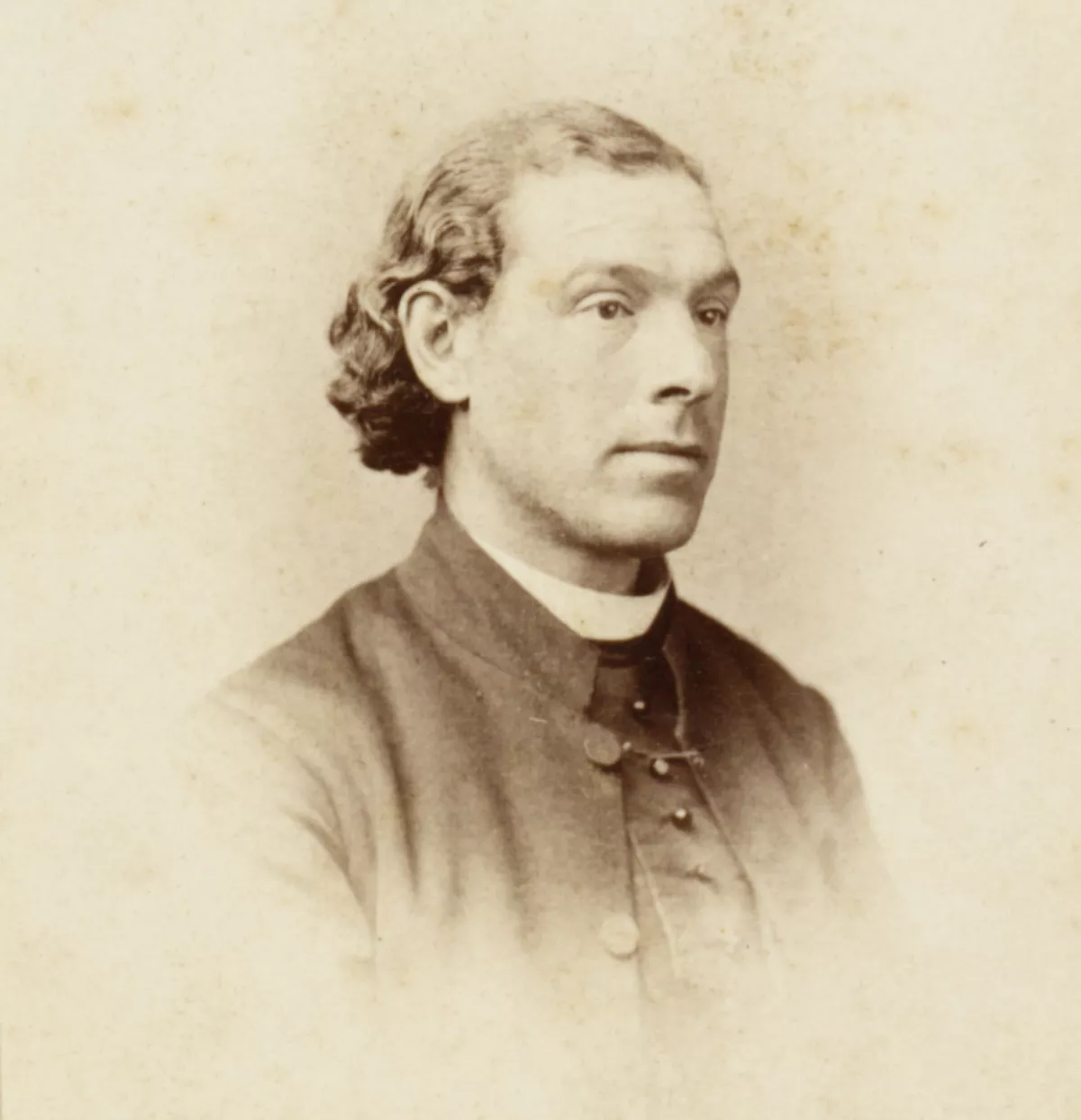
 1.
1. Julian Tenison-Woods was baptised by the Rev John White of the Royal Belgian Chapel, Southwark, and confirmed by Cardinal Wiseman, at that time Vicar-Apostolic of the London District.
 1.
1. Julian Tenison-Woods was baptised by the Rev John White of the Royal Belgian Chapel, Southwark, and confirmed by Cardinal Wiseman, at that time Vicar-Apostolic of the London District.
In 1846, Julian Tenison-Woods obtained a position in The Times office, but after a few weeks went to live at Jersey with his mother whose health had failed.
Julian Tenison-Woods returned to London in less than two years and resumed his position at The Times office.
Julian Tenison-Woods's health began to fail and he studied at Marist seminaries near Toulon, France, where he taught English at a naval college.
In 1854, in England, Julian Tenison-Woods met Robert Willson, the first Roman Catholic Bishop of Hobart.
Julian Tenison-Woods worked for the Adelaide Times as sub-editor for a year, then in April 1856 entered the "Sevenhill" Jesuit college near Clare, South Australia to prepare for ordination.
Julian Tenison-Woods was ordained as a diocesan priest on 4 January 1857 and took charge of the large parish at Penola.
Julian Tenison-Woods published his first book, Geological Observations in South Australia, in 1862.
Julian Tenison-Woods made regular long journeys over his large parish and systematically visited every place where he would find a member of his church.
Julian Tenison-Woods joined an exploring party that was starting for the interior and began a methodical study of geology and mineralogy.
Julian Tenison-Woods met Adam Lindsay Gordon, of whom he afterwards wrote an account which appeared in the Melbourne Review of April 1884.
Early in 1867, Julian Tenison-Woods was transferred to Adelaide and was appointed director-general of Catholic education and secretary to Bishop Laurence Sheil, with the clerical style of The Very Reverend.
Julian Tenison-Woods founded a small monthly magazine called the Southern Cross in 1867.
Julian Tenison-Woods was then involved, initially with Archdeacon Russell and Father Byrne, in production of the monthly Southern Cross and Catholic Herald, which was dropped after the weekly Irish Harp and Farmers' Herald had become firmly established and the two amalgamated around November 1873 as The Harp and Southern Cross.
Julian Tenison-Woods has been described as a "rigid teetotaller" and a "stern advocate" of temperance for many years.
Julian Tenison-Woods was working long hours and under many anxieties, his health again broke down.
The result was that Julian Tenison-Woods was deposed from his various positions and he left Adelaide.
Julian Tenison-Woods began working in the Bathurst diocese and in 1873 went to Brisbane and worked as a missionary for almost a year.
Julian Tenison-Woods kept in touch with other scientists and built up a library of scientific books.
Julian Tenison-Woods published his first book, Geological Observations in South Australia, in 1862.
In 1878, Julian Tenison-Woods joined the Linnean Society of New South Wales, he had taken up his scientific work again after leaving Adelaide.
Julian Tenison-Woods was elected president of the society in 1880 and took much interest in its activities.
Julian Tenison-Woods had been for many years a fellow of the Geological Society.
Julian Tenison-Woods's first botanical work was an acknowledgement of the specimens in the [Ninety Mile Desert] that he collected for the [National Herbarium of Victoria].
Julian Tenison-Woods wrote botanical papers himself, including in the Proceedings of the Linnean Society of New South Wales:.
In 1883, Julian Tenison-Woods was invited by his friend and governor of Singapore, Sir Frederick Weld, to undertake a scientific tour in the Straits Settlements.
Julian Tenison-Woods travelled extensively in Java, the adjacent islands and the Philippines, and provided the British government with a valuable confidential report on the coal resources of the East.
Julian Tenison-Woods found a home in Sydney in one of the charitable communities he had founded, but was told by Cardinal Francis Moran that if he wished to remain in the diocese and exercise his priestly faculties, he was to take up his residence in a place appointed for him.
Julian Tenison-Woods had received and given away a large amount paid to him for his scientific work for the government and was now poor and feeble.
Julian Tenison-Woods did not lack friends and was well-cared for.
Julian Tenison-Woods dictated his partly fanciful autobiographical memoir to his carers.