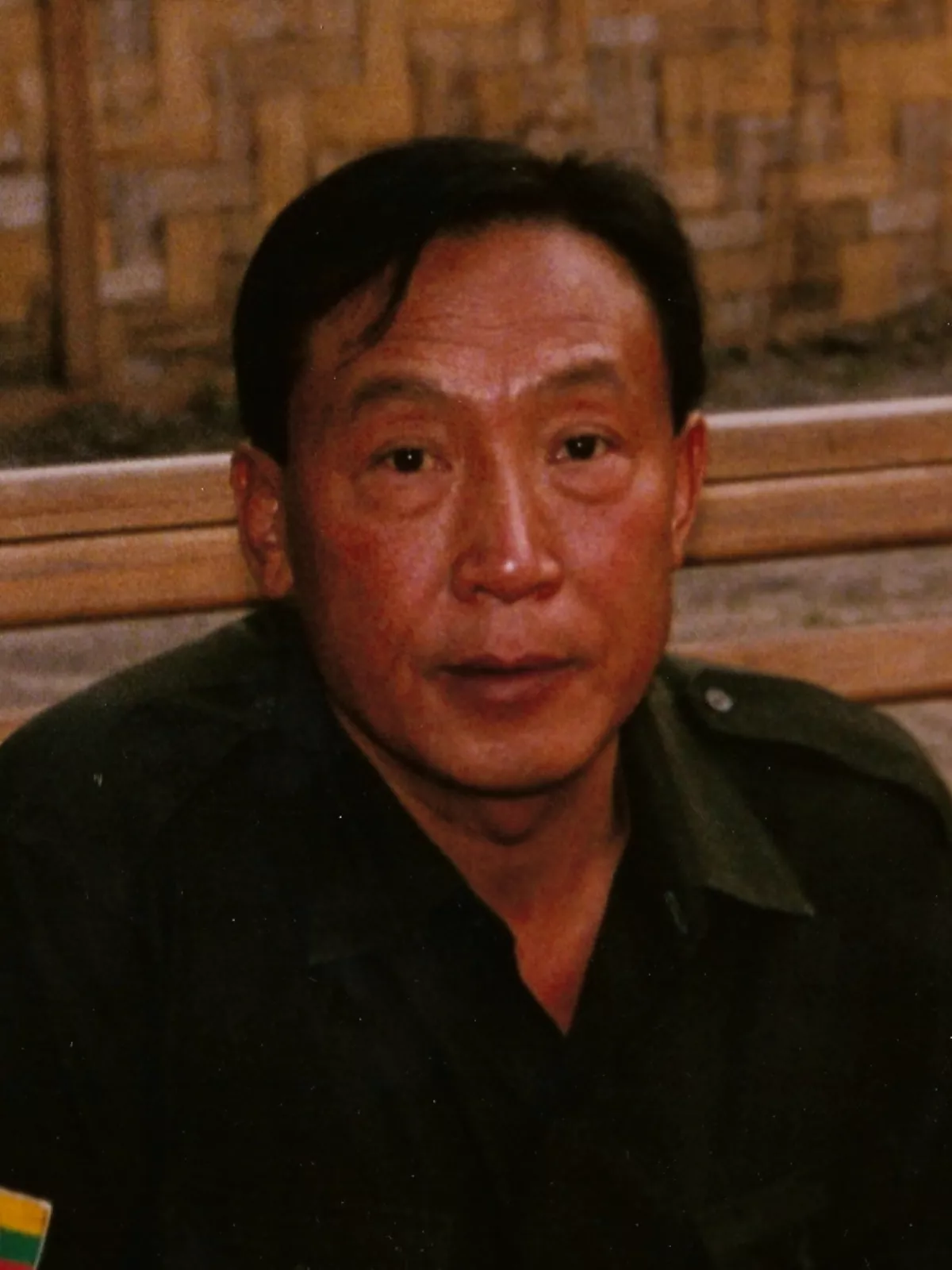
 1.
1. Khun Sa was born in Hpa Hpeung village, in the Loi Maw ward of Mongyai, Northern Shan State, Burma.
 1.
1. Khun Sa was born in Hpa Hpeung village, in the Loi Maw ward of Mongyai, Northern Shan State, Burma.
Khun Sa was dubbed the "Opium King" in Myanmar due to his massive opium smuggling operations in the Golden Triangle, where he was the dominant opium warlord from approximately 1976 to 1996.
Khun Sa was primarily known by his Han Chinese name, Chang Chi-fu.
Khun Sa's mother married a local tax collector, but two years later she died as well.
Khun Sa was raised largely by his Han grandfather, who was the headman of the village in which he was born, Loi Maw.
Khun Sa received no formal education but had military training as a soldier with Chinese Nationalist forces that had fled into Burma after the victory of Mao's Communists in 1949.
Khun Sa formed his first independent band of young men when he was sixteen, and when his organization grew to several hundred men he became independent of the Kuomintang.
Many government-supported warlords, including Khun Sa, used their profits from the opium trade to buy large supplies of military equipment from the black markets in Laos and Thailand, and were soon better equipped than the Burmese army.
Khun Sa held an important pass in Loi Maw, restricting the movements of local communist rebels.
In 1969, delegates from a local ethnic rebel group, the Shan State Army, began to hold secret talks with Khun Sa, attempting to persuade him to change sides and join them.
Khun Sa expressed interest, but details of the meeting were discovered by the Burmese army, and he was arrested On October 29,1969, at Heho Airport in Taunggyi while returning from a business trip in Tachilek, near the Thai border.
Khun Sa's release was secretly brokered by Thai General Kriangsak Chomanan.
Khun Sa commanded 20,000 men, and his personal army was better armed than the Burmese military.
Khun Sa's notoriety led the American government to put a $2 million bounty on him.
Khun Sa renamed his group the Shan United Army, began to claim that he was fighting for Shan autonomy against the Burmese government, and told international reporters that his people only grew drugs to pay for clothes and food.
Khun Sa relocated his base of operations to the border town of Homein, established a local heroin-refining industry, and resumed a working relationship with the Burmese military and intelligence services, who again tolerated his presence in return for fighting other ethnic and communist rebels.
Khun Sa maintained a cordial relationship with the highest-ranking Burmese general in the region, Maung Aye, and established relationships with many foreign socialites and business people, including Lady and Lord Brockett, and James "Bo" Gritz.
Khun Sa's organization maintained a trade organization in the government-held city of Taunggyi and re-established cordial relations with the Thai intelligence service after relocating to Burma.
In 1985, Khun Sa merged his Shan United Army with another rebel group, the "Tai Revolutionary Council" of Moh Heng, a faction of the Shan United Revolutionary Army, forming the Mong Tai Army.
The Burmese army did conduct anti-narcotics operations at the time in many other areas of Burma, but the area controlled by Khun Sa was one of the few areas not targeted.
In 1988, Khun Sa was interviewed by Australian journalist Stephen Rice, who had crossed the border from Thailand into Burma illegally.
Khun Sa offered to sell his entire heroin crop to the Australian Government for A$50m a year for the next eight years, a move that would have immediately destroyed half the world's heroin supply.
Soon thereafter, in January 1990 Khun Sa was indicted in absentia by an American federal grand jury on drug trafficking charges.
Khun Sa exported his heroin through a network of underworld contacts and brokers based in Thailand, Yunnan, Macao, Hong Kong, and Singapore.
Khun Sa surrendered to the Burmese government on January 5,1996, gave up control of his army, and moved to Rangoon with a large fortune and four young Shan mistresses.
Khun Sa ran a large ruby mine, and invested in a new highway running from Yangon to Mandalay.
Khun Sa died on 26 October 2007 in Yangon at the age of 73.
Khun Sa's remains were cremated and buried at Yayway Cemetery, North Okkalapa Township, Yangon, Myanmar.
Khun Sa was building a hydro power plant, but after his departure construction on that project was halted.
Khun Sa built an 18-hole golf course for foreign visitors and a functional water and electrical infrastructure.
Khun Sa was married to Nan Kyayon with whom he had eight children: five sons and three daughters.
Khun Sa's children, listed in order of their birth, are Nang Long, Zarm Merng, Zarm Herng, Nang Kang, Zarm Zeun, Zarm Myat, Nang Lek, and Zarm Mya.
In 1989 Khun Sa told Karen Petersen, a reporter for People magazine, that he had a second wife in Bangkok.
Khun Sa is mentioned in Japanese manga and anime Black Lagoon, for his role on the drug trade in Southeast Asia as well as one of his subordinates being targeted by the NSA.
Khun Sa was featured in a 1990 edition of The Cook Report entitled "Heroin Highway".
Khun Sa is portrayed by Ric Young in the 2007 film American Gangster.
Khun Sa is mentioned in Hong Kong movie To Be Number One in which real life triad boss Ng Sik-ho connects to him circa 1973 in order to supply Hong Kong domestic supply and export.