 1.
1. Leto is the daughter of the Titans Coeus and Phoebe, and the sister of Asteria.
 1.
1. Leto is the daughter of the Titans Coeus and Phoebe, and the sister of Asteria.
Hera is the one to have sent the monstrous Python, a giant serpent, against Leto to pursue and harm her.
Leto eventually found an island, Delos, that was not joined to the mainland or attached to the ocean floor, therefore it was not considered land or island and she could give birth.
In some stories, Hera further tormented Leto by delaying her labour, leaving Leto in agony for days before she could deliver the twins, especially Apollo.
Besides the myth of the birth of Artemis and Apollo, Leto appears in other notable myths, usually where she punishes mortals for their hubris against her.
Leto then asks her twin children to avenge her, and they respond by shooting all of Niobe's sons and daughters dead as punishment.
Usually, Leto is found at Olympus among the other gods, having gained her seat next to Zeus, or accompanying and helping her son and daughter in their various endeavors.
In Mycenaean Greek her name has been attested through the form Latios, meaning "son of Leto" or "related to Leto", and Lato.
Leto was identified from the fourth century onwards as the principal local mother goddess of Anatolian Lycia, as the region became Hellenized.
In Greek inscriptions, the children of Leto are referred to as the "national gods" of the country.
Leto is exceptional among Zeus' divine lovers for being the only one who was tormented by Hera, who otherwise only directs her anger toward mortal women and nymphs, but not goddesses, thus being treated more in line with mortal women than divine beings in mythology.
Leto is the daughter of the Titans Phoebe and Coeus.
Leto is sometimes called the daughter of Coeus with no mother specified.
However, Diodorus Siculus states clearly that Leto was born in Hyperborea and not in Kos.
Leto's sister is Asteria, who is, by the Titan Perses, the mother of Hecate.
Unlike Leto, Asteria did not reciprocate his love and escaped his advances by transforming herself into a bird and then a wandering island, later renamed Delos.
In Homeric texts, Leto is shown standing next to Zeus in the absence of Hera almost in the manner of a married wife, and not just one mistress among the many.
The Homeric Hymn 3 to Apollo is the oldest extant account of Leto's wandering and birth of her children, but it is only concerned with the birth of Apollo, and treats Artemis as an afterthought; in fact the hymn does not even state that Leto's children are twins, and they are given different birthplaces.
The first to speak of Leto's children being twins is a slightly later poet, Pindar.
Antoninus Liberalis hints that Leto came down from Hyperborea in the guise of a she-wolf, or that she sought out the "wolf-country" of Lycia, formerly called Tremilis, which she renamed to honour wolves that had befriended her.
Leto found the barren floating island of Delos, still bearing its archaic name of Asterios, which was neither mainland nor a real island and gave birth there, promising the island wealth from the worshippers who would flock to the obscure birthplace of the splendid god who was to come.
Leto considered the island of Kos for a birthplace, but Apollo, still in the womb, advised his mother against giving birth to him there, saying Kos was fated to be the birthplace of someone else.
Leto later urged his mother to go to Delos, who used to Leto's sister Asteria.
Callimachus wrote that it is remarkable that Leto brought forth Artemis, the elder twin, without travail despite her exhausting journey.
Leto was threatened and assailed in her wanderings by ancient earth creatures that had to be overcome, chthonic monsters of the ancient earth and old ways, and these became the enemies of Apollo and Artemis for attempting to cause harm to their mother.
One of the monsters that came across Leto was the dragon Python, which lived in a cleft of the mother-rock beneath Delphi and beside the Castalian Spring.
Once Python knew that Leto was pregnant to Zeus, he hunted her down with the intention to harm her, and once he could not find her, he returned to Parnassus.
Leto fought alongside the other gods during the Gigantomachy, as evidenced from her depiction on the east frieze of the Pergamon Altar, fighting a Giant between her children Artemis and Apollo; None of the other Gigantomachy depictions includes Leto, although her presence is conjectured in one of the missing sections of the Siphnian frieze from Delphi, another relief depiction of the battle of the gods against the Giants.
Leto was equated with the Egyptian goddess Wadjet, a cobra goddess, however other Egyptian gods and goddesses were connected to shrew mice.
Galatea fled to the temple of Leto, and prayed to the goddess to change Leucippus into an actual boy.
Leto is said to have despaired at the sight of his unkempt and disheveled locks, which had been admired by even Hera.
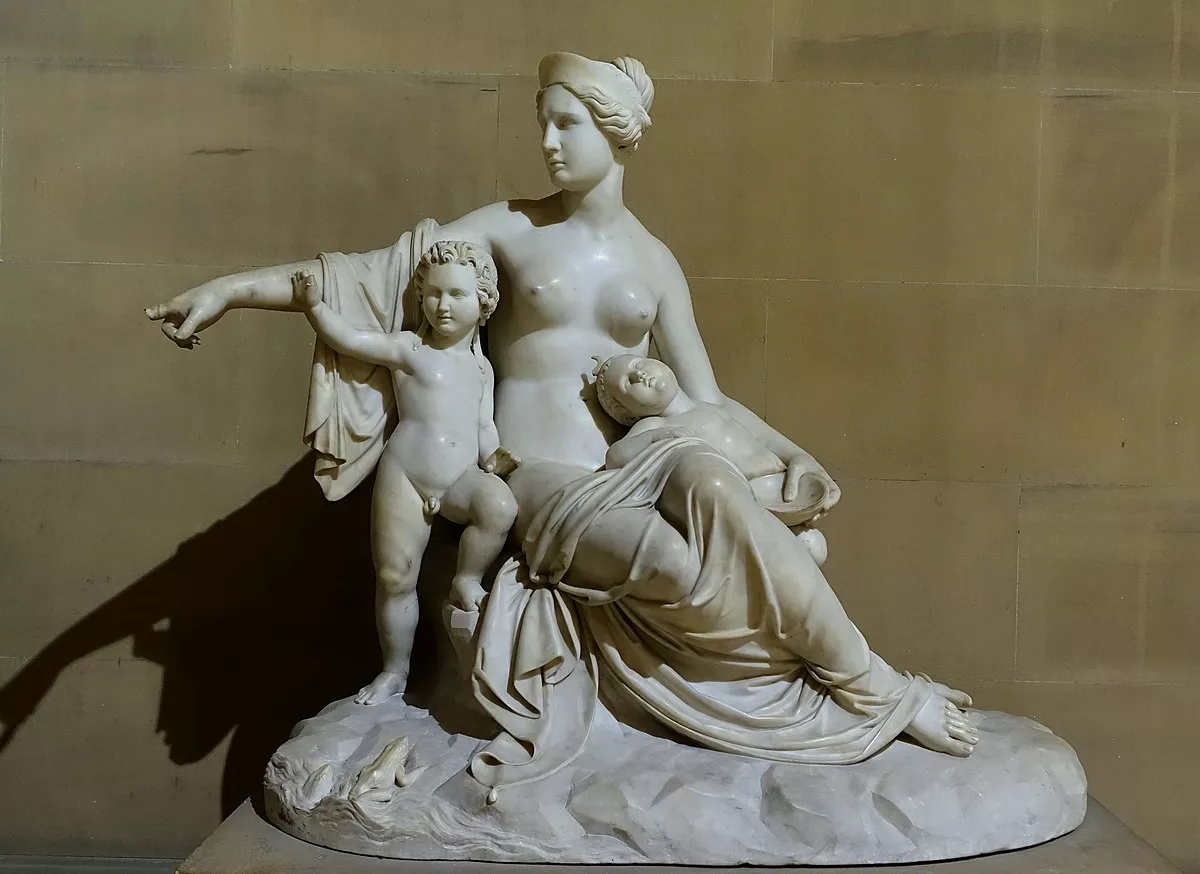
Leto turned them into frogs for their inhospitality, forever doomed to swim in the murky waters of ponds and rivers.
The Niobe narrative appears in Ovid's Metamorphoses where Leto has demanded the women of Thebes to go to her temple and burn incense.
Niobe, queen of Thebes, enters in the midst of the worship and insults the goddess, claiming that having beauty, better parentage and more children than Leto, she is more fit to be worshipped than the goddess.
Leto sarcastically says that not all goddesses can be blessed to be the mother of gods like Hephaestus, and calmly tells Hera that she might feel confident belittling everyone due to her status as queen of the gods as the wife of Zeus, but she will cry and sob all the same the next time he shall abandon her for the love of some mortal woman.
Leto was intensely worshipped in Lycia, Asia Minor, where worship was particularly strong and widespread.
Leto had a temple in Attica as well as an altar, along with her children Apollo and Artemis in the village Zoster.
Leto was revered in Sparta and the rest of Laconia.
Leto might have had a cult center in Lesbos as well.
Leto was worshipped in Crete, whether one of "certain Cretan goddesses, or Greek goddesses in their Cretan form, influenced by the Minoan goddess".
Leto's capture by Tityus and subsequent rescue by Artemis and Apollo was a very popular subject.
Ancient representations of Leto holding her infant children however are rare.
The myth of Leto transforming the mortals into frogs of the pond became very popular in post-antiquity art.
In Crete, at the city of Dreros, Spyridon Marinatos uncovered an eighth-century post-Minoan hearth house temple in which there were found three unique figures of Apollo, Artemis and Leto made of brass sheeting hammered over a shaped core.