 1.
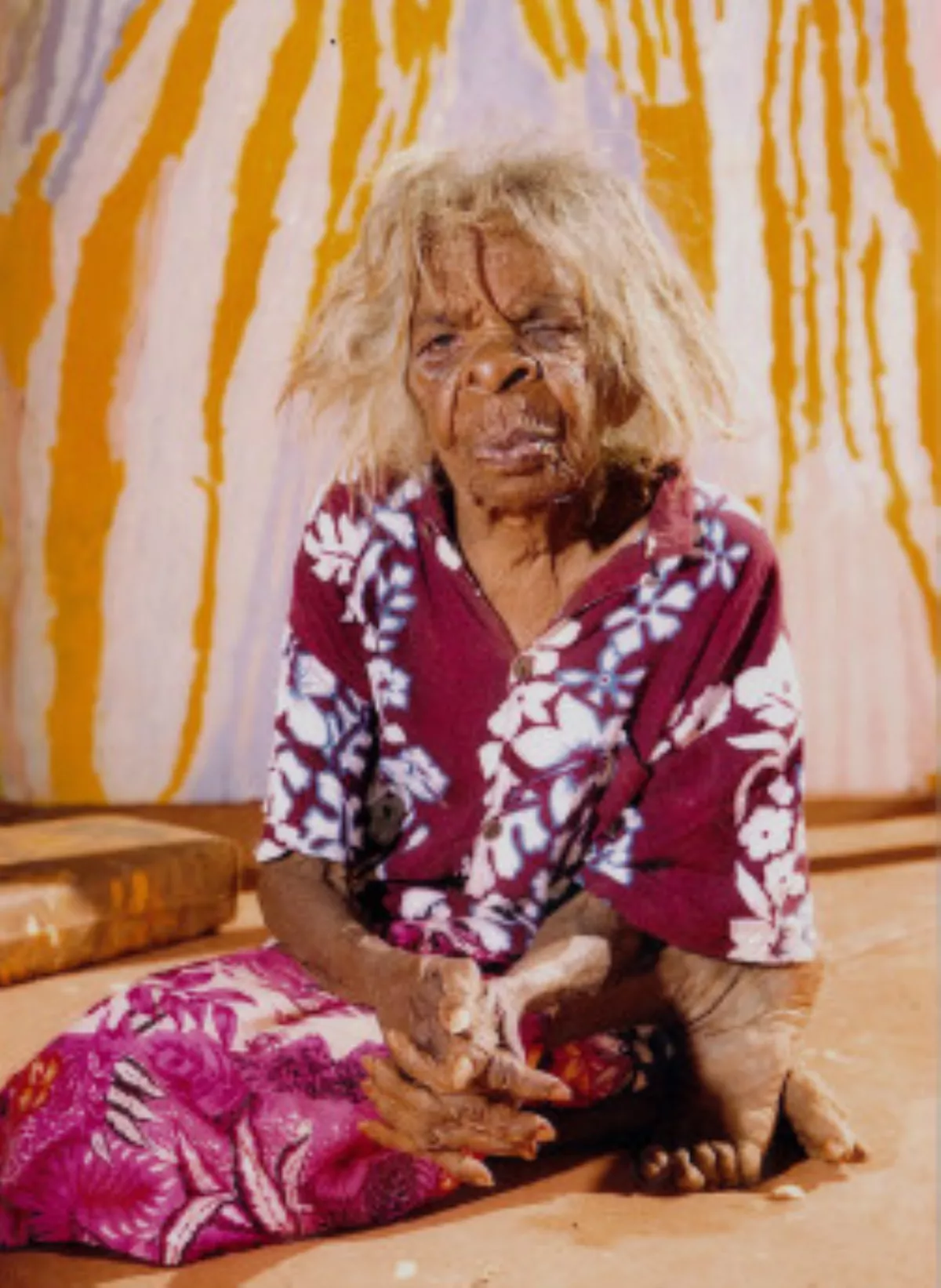
1. Makinti Napanangka lived in the communities of Haasts Bluff, Papunya, and later at Kintore, about 50 kilometres north-east of the Lake MacDonald region where she was born, on the border of the Northern Territory and Western Australia.
 1.
1. Makinti Napanangka lived in the communities of Haasts Bluff, Papunya, and later at Kintore, about 50 kilometres north-east of the Lake MacDonald region where she was born, on the border of the Northern Territory and Western Australia.
Makinti Napanangka began painting Contemporary Indigenous Australian art at Kintore in the mid-1990s, encouraged by a community art project.
Makinti Napanangka's work was shown in the major indigenous art exhibition Papunya Tula: Genesis and Genius, at the Art Gallery of New South Wales.
Makinti Napanangka was a member of the Papunya Tula Artists Cooperative, but her work has been described as more spontaneous than that of her fellow Papunya Tula artists.
Makinti Napanangka's year of birth is uncertain, but several sources indicate she was born around 1930, although other sources indicate she may have been born as early as 1922 or as late as 1932 at a location described by some sources as Lupul rockhole but by one major reference work as Mangarri.
Makinti Napanangka was a member of the Pintupi group of indigenous people, who are associated with the communities of Papunya, Kintore, and Kiwirrkura.
The uncertainty around Makinti Napanangka's date and place of birth arises from the fact that Indigenous Australians often estimate dates of birth by comparison with other events, especially for people born before contact with European Australians.
Makinti Napanangka was one of a large group of people who walked into Haasts Bluff in the early 1940s, together with her husband Nyukuti Tjupurrula, and their son Ginger Tjakamarra, born around 1940.
The population moved to Papunya in the late 1950s, where Makinti Napanangka had another child, Jacqueline Daaru, in 1958.
Makinti Napanangka had a daughter, Winnie Bernadette, in 1961 in Alice Springs.
Makinti Napanangka was one of the "Kintore ladies" who joined earlier generations of the famous Papunya Tula artists, and was referred to as "number one" by her fellow artists, of whom she was considered a leader.
Makinti Napanangka painted with the Papunya Tula Artists Cooperative, in which she was a shareholder, from 1996, alongside artist such as Ningura Napurrula.
Makinti Napanangka's works were selected to hang in five consecutive National Aboriginal and Torres Strait Islander Art Award exhibitions, beginning in 1997.
Makinti Napanangka's painting sold for A$18,500, a significant contribution to the quarter of a million dollars raised.
Makinti Napanangka participated in some major group exhibitions, such as Papunya Tula: Genesis and Genius at the Art Gallery of New South Wales, and Colour Power at the National Gallery of Victoria, as well as having had a small number of solo exhibitions at private galleries, including the gallery of influential art dealer Gabrielle Pizzi.
Makinti Napanangka's work was selected for inclusion in the 2012 Sydney Biennale.
Makinti Napanangka's works, including her Clemenger Award and NATSIAA paintings, are created with synthetic polymer on linen or canvas.
Makinti Napanangka's works reflect those themes, and are particularly associated with a rockhole site, Lupul, and with Kungka Kutjarra.
Makinti Napanangka's untitled painting in the Genesis and Genius exhibition was based on Kungka Kutjarra, while the painting that won the 2008 Telstra award related to Lupul.
Makinti Napanangka's style evolved over time, beginning with gestural brush strokes in ordered compositions, and developing into more closely interwoven representations of the hair-string skirts and designs reflecting those used in body painting.