 1.
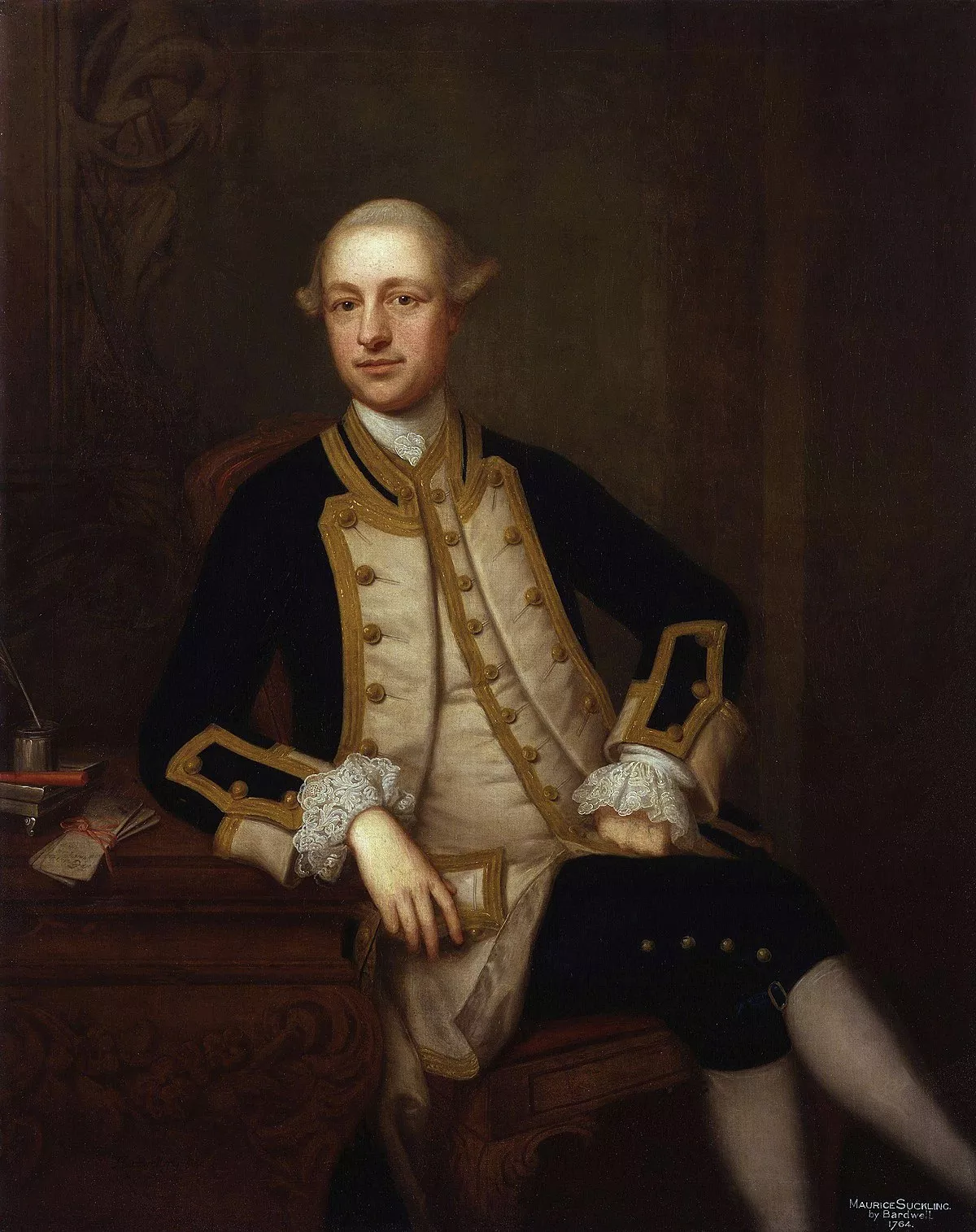
1. Captain Maurice Suckling was a British Royal Navy officer of the eighteenth century, most notable for starting the naval career of his nephew Horatio Nelson and for serving as Comptroller of the Navy from 1775 until his death.
 1.
1. Captain Maurice Suckling was a British Royal Navy officer of the eighteenth century, most notable for starting the naval career of his nephew Horatio Nelson and for serving as Comptroller of the Navy from 1775 until his death.
Maurice Suckling was employed in the aftermath of the Capture of Belle Ile in 1761 destroying French fortifications on the Ile-d'Aix and went on half pay at the end of the war in 1763.
Maurice Suckling was given his next command during the Falklands Crisis of 1770, and took his nephew Nelson with him.
Maurice Suckling left his ship in 1773 and was initially rebuffed in his attempts to gain fresh employment with the navy because of the ongoing peace, but in 1775 First Lord of the Admiralty John Montagu, 4th Earl of Sandwich, appointed him Comptroller of the Navy.
Maurice Suckling was competent in his new role and oversaw the Royal Navy's mobilisation when the American Revolutionary War began.
Maurice Suckling was able to use his powerful position to again assist Nelson, forming part of the board that passed him for promotion to lieutenant in 1777.
Maurice Suckling continued throughout the period to assiduously attend meetings of the Navy Board, but was increasingly hampered by a long-term illness that caused him considerable pain.
Maurice Suckling's father was the Reverend Maurice Suckling and his mother Anne Turner.
Maurice Suckling lived in Barsham until the age of four when his father died.
Maurice Suckling did however have the support of considerable patronage from the powerful Walpole, and because of this he was able to find a place within the Royal Navy.
In Newcastle Maurice Suckling saw service in the Western Approaches, the English Channel, and off Gibraltar and Lisbon.
Maurice Suckling was at this stage not actually eligible to take the examination, by the rules needing to be a year older and to have another seven months of sea service.
Maurice Suckling was immediately promoted and appointed to serve as fourth lieutenant of the 70-gun ship of the line HMS Burford.
The ship was at the time serving on the North America Station, and Maurice Suckling took passage out in a merchant ship to take up his new command.
Lys was only armed en flute, and Maurice Suckling was ordered to sail her back to Britain.
Alongside his promotion, Maurice Suckling was given command of the 60-gun ship of the line HMS Dreadnought which was the flag ship of Townshend, now a rear-admiral.
Maurice Suckling was able to occasionally take his ship on patrols around the coast of Santo Domingo.
When he suggested that the French were looking for a battle, Maurice Suckling replied "I think it would be a pity to disappoint them".
Maurice Suckling began the battle at 3:20pm by engaging the French flag ship, the 74-gun ship of the line Intrepide.
Palmier fired into Dreadnoughts rigging and, with his ship's movement disabled, Maurice Suckling was unable to stop the French ship from escaping.
Maurice Suckling, who had told tales of his naval exploits to Horatio while on half pay, accepted him at the direct request of Nelson's father Edmund and did not himself think that it was the right choice, saying:.
Aware that the monotony of service on board a guard ship would not provide the practical experience necessary for Nelson's naval career, Maurice Suckling organised for a Hibbert, Purrier and Horton ship captain who had served under him in Dreadnought to take Nelson to the West Indies.
Maurice Suckling continued on in Triumph, his duties at the time of Nelson's return including hosting on board First Lord of the Admiralty John Montagu, 4th Earl of Sandwich.
Maurice Suckling returned to half pay; he was still in his prime, a handsome and slim man despite some gout in his right hand and a thinning hairline.
Maurice Suckling showed an interest in working ashore when positions in Newfoundland and Jamaica arose in 1775.
The naval experience that Maurice Suckling brought to the position was of great value to Sandwich, who went about reforming naval administration with particular emphasis on making Royal Navy shipyards more productive.
Maurice Suckling proved adept as head of the Navy Board, initially in peace and then during the American Revolutionary War.
Maurice Suckling attended the majority of meetings called by the Navy Board, often six days a week, overseeing both the growth of the navy and the creation of a fleet of 416 troop transports to convey the army across to America.
Nelson was, as Maurice Suckling had been, underage for the position but this was ignored and he passed, being appointed to serve in the 32-gun frigate HMS Lowestoffe.
The naval historian N AM Rodger argues that Suckling was a "less successful choice" than Palliser had been as Comptroller of the Navy because of this, but that he was still an able man.
Maurice Suckling was buried in the chancel of Barsham Church.
Maurice Suckling is most remembered as the man who was instrumental in beginning and supporting Nelson's naval career as he grew to become a national hero.
Maurice Suckling left his sword, said to have previously been owned by Galfridus Walpole, to Nelson.