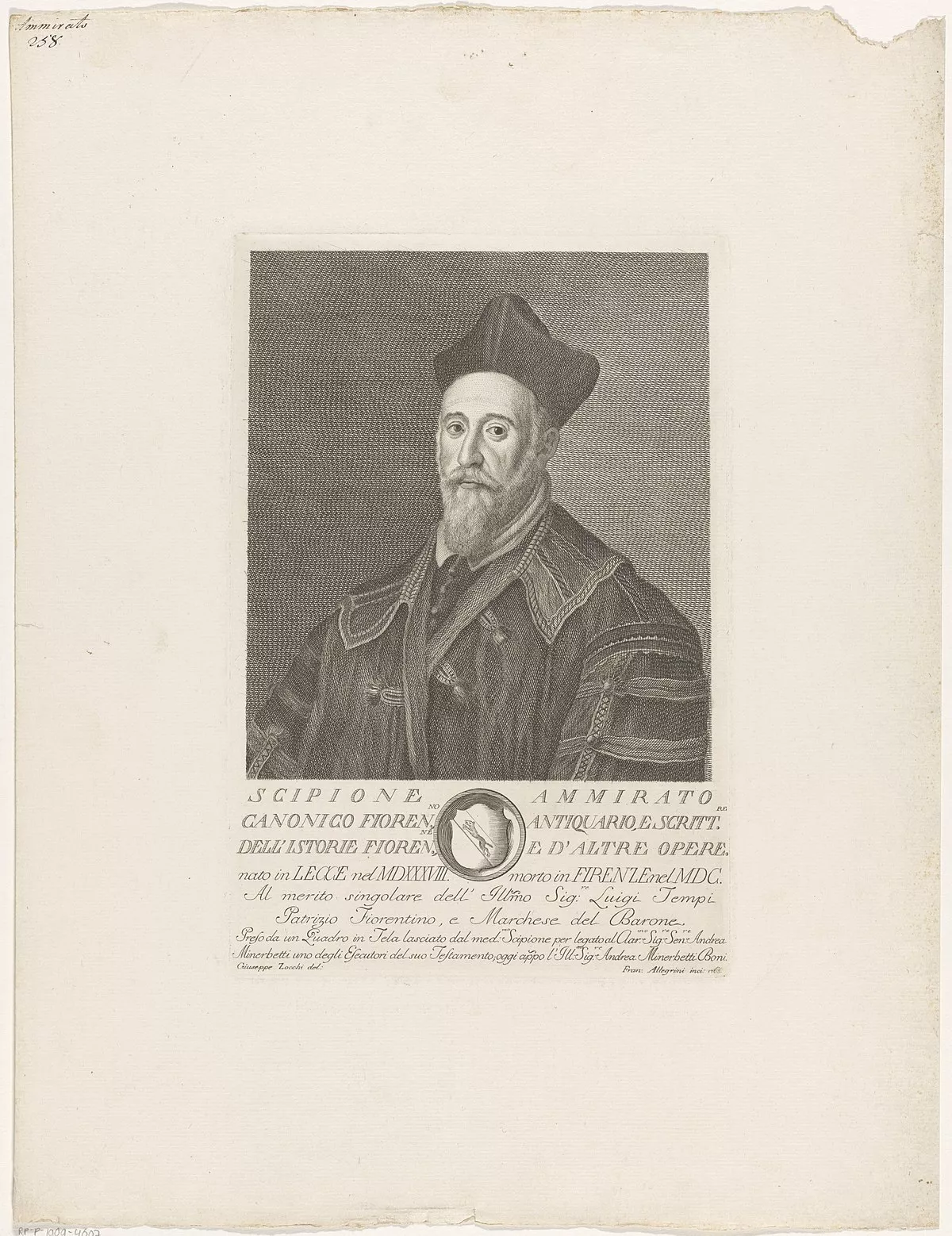
 1.
1. Scipione Ammirato is regarded as an important figure in the history of political thought.
 1.
1. Scipione Ammirato is regarded as an important figure in the history of political thought.
Unlike Botero and Lipsius, Scipione Ammirato did not see Tacitism as a surrogate form of Machiavellianism.
Scipione Ammirato was born at Lecce in the Kingdom of Naples in 1531, of a noble family of Florentine origin.
Scipione Ammirato devoted himself to the study of classical literature, to satisfy his interest in the ancient world.
Scipione Ammirato attended literary clubs, striking up a friendship with the poet Berardino Rota, the historian Angelo di Costanzo and the polymath Bartolomeo Maranta.
Scipione Ammirato afterwards travelled about Italy in quest of occupation; he resided some time at Rome, Padua and Venice, where he became secretary to Alessandro Contarini, a Venetian patrician, and became acquainted with Sperone Speroni, Vittoria Colonna, and Pietro Aretino.
Scipione Ammirato contributed the Argomenti dei canti to the edition of Ludovico Ariosto's Orlando Furioso published in 1556 by Vincenzo Valgrisi, with the collaboration of Girolamo Ruscelli.
Scipione Ammirato was forced to hurriedly abandon the city on account of the discovery of his love affair with a member of the Contarini family.
Scipione Ammirato took refuge in his native Lecce where in 1558 he founded the Accademia dei Trasformati.
Scipione Ammirato entered the patronage network of the reforming churchman Girolamo Seripando, to whom he dedicated the philosophical dialogue Il Dedalione o ver del poeta.
Scipione Ammirato then went initially to Naples but was not supported by the Spanish who refused to appoint him official historian of the viceroyalty.
Scipione Ammirato became a member of the Florentine Accademia degli Alterati, under the pseudonym Il Trasformato.
Several of Scipione Ammirato's works were edited after his death by del Bianco.
Scipione Ammirato invoked Tacitus to refute Machiavelli's secular republicanism and composed his Discorsi as a counter to Machiavelli's Discourses on Livy.
Scipione Ammirato blames Machiavelli for having subjugated the Christian religion to the demands of the State.
Scipione Ammirato accepted the derogation from the dictates of natural and positive law only when the preservation of the state was at stake, but rejected as a sign of tyranny any infringement of laws on the grounds of desire for glory or private interest.
Scipione Ammirato made it clear that though reason of state might authorize a ruler to set aside positive law, it did not permit him to act in violation of divine law.
Scipione Ammirato left several manuscript works, among others a continuation of the Monte Cassino Chronicle, and his own autobiography, which is kept in the library of Santa Maria la Nuova of Florence.