 1.
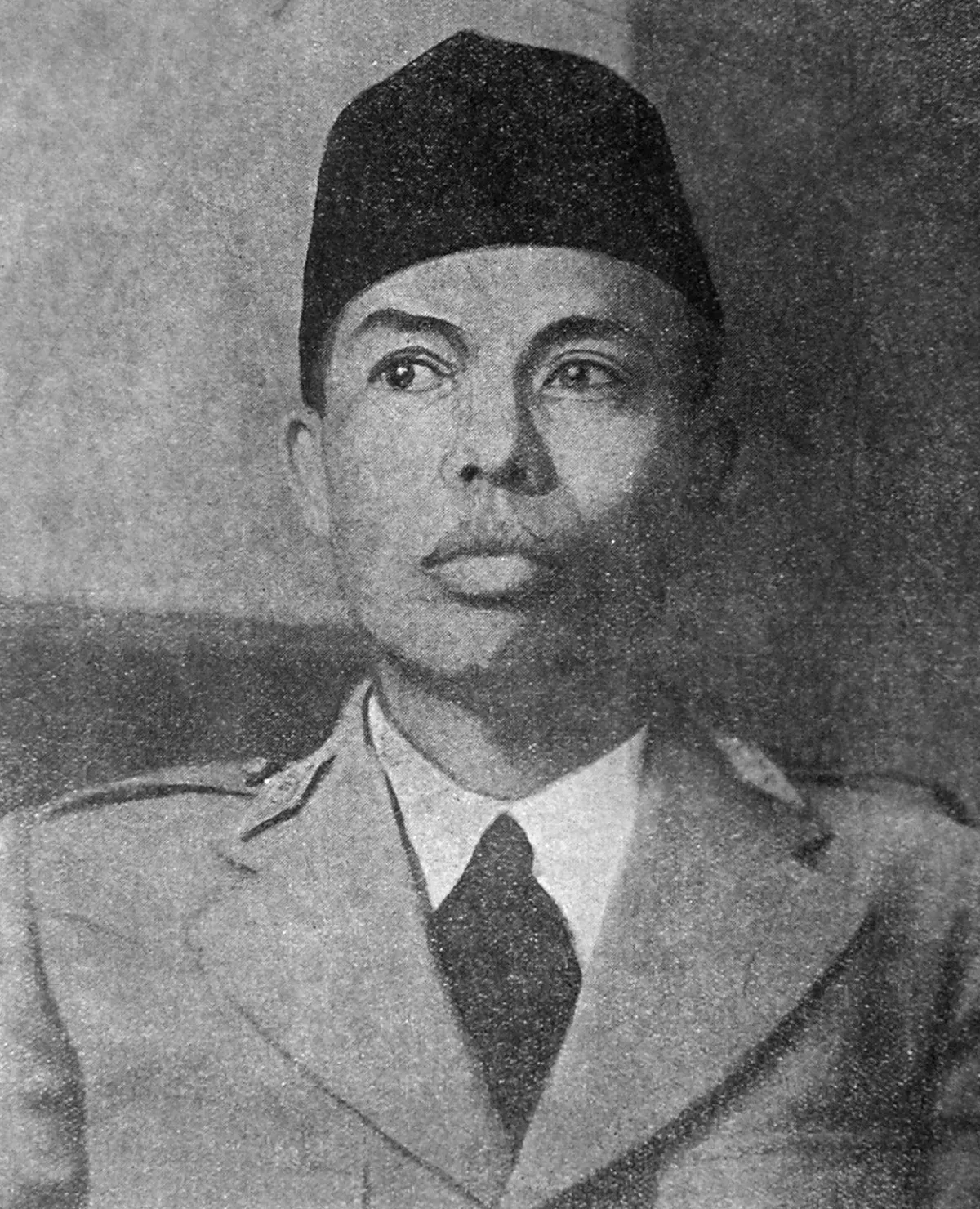
1. Sudirman was an Indonesian military officer and revolutionary during the Indonesian National Revolution and the first commander of the Indonesian National Armed Forces.
 1.
1. Sudirman was an Indonesian military officer and revolutionary during the Indonesian National Revolution and the first commander of the Indonesian National Armed Forces.
On 12 November 1945, at an election to decide the military's commander-in-chief in Yogyakarta, Sudirman was chosen over Oerip Soemohardjo in a close vote.
Sudirman later blamed these issues for his tuberculosis, which led to his right lung collapsing in November 1948.
In late 1949 Sudirman's tuberculosis relapsed, and he retired to Magelang, where he died slightly more than a month after the Dutch recognised Indonesia's independence.
Sudirman's death was mourned throughout Indonesia, with flags flown at half-mast and thousands gathering to see his funeral convoy and procession.
Sudirman featured prominently on the 1968 series of rupiah banknotes, and has numerous streets, museums, and monuments named after him.
Sudirman was born to Karsid Kartawiraji and Siyem while they lived with Siyem's sister Tarsem, one of three women married to the sub-district head Raden Cokrosunaryo, in Rembang, Bodas Karangjati, Purbalingga, Dutch East Indies.
When Cokrosunaryo retired from his position as chief in late 1916, Sudirman went with the family to Manggisan, Cilacap, where he was raised.
Karsid died when Sudirman was six, at which time Siyem left the boys with her brother-in-law and went back to her village at Parakan Onje, Ajibarang.
Sudirman was raised with stories of heroic deeds and taught the etiquette and ways of the priyayi, or noble caste, as well as the work ethic and simplicity of the wong cilik, or commoners.
Sudirman was entrusted with performing both the adhan and iqama, or calls to prayer.
When he was seven years old, Sudirman was enrolled at a school for natives, where he was an average student.
Sudirman studied diligently at school; his teacher Suwarjo Tirtosupono later recalled that Sudirman would already be studying second-term lessons while the class was still in term one.
Sudirman became more religious under the guidance of his teacher Raden Mohamad Kholil; his classmates named him "hajji" because of his devotion to his prayers, and Sudirman took up preaching to other students.
Sudirman helped establish a branch of the Hizboel Wathan, an organisation similar to the Boy Scouts, which was run by the Islamic establishment Muhammadiyah.
Sudirman became the leader of the Cilacap division after graduating from Wirotomo; he was tasked with deciding and planning his groups' activities.
Sudirman emphasised the need for religious studies, insisting that the contingents from Cilacap attend Muhammadiyah conferences throughout Java.
Sudirman taught the younger members about the history of Islam and the importance of morality, while with older members he enforced near-military discipline.
One of his students later recalled that Sudirman was an even-handed and patient teacher who would mix humour and nationalism in his lessons; this made him popular with the students.
Sudirman was active in fundraising, both for the needs of his school and the construction of others.
Sudirman was elected as Chair of the Banyumas District of the Muhammadiyah Youth Group at the end of 1937.
Sudirman was later put in charge of Youth Group activities throughout Central Java and spent much of his free time travelling and preaching Islam, putting an emphasis on self-awareness.
Sudirman, respected in the community, was asked to lead the Cilacap chapter.
In Cilacap, Sudirman's school had been closed and turned into a military outpost; this was part of a widespread effort to close private schools.
Sudirman was involved in several social and humanitarian organisations during this period, including as chair of the Indonesian People's Cooperative.
In early 1944, after a year as a representative at the Japanese-run regency council board, Sudirman was asked to join the Defenders of the Homeland ; the Japanese occupation government had established PETA in October 1943 to help repel any Allied invasion, and were focused on recruiting younger men, those who had "not yet been 'contaminated" by Dutch rule.
Unfamiliar with Jakarta, Sudirman refused, instead offering to lead forces in Kroya.
Sudirman kept Oerip to serve as chief of staff under him.
Ultimately, Sudirman was chosen as his loyalty was undoubted, while Oerip's former pledge of loyalty to the Dutch led to him being viewed with suspicion.
Sudirman was replaced as head of the Fifth Division by Colonel Sutiro, and began to focus on strategic problems.
However, rumours among the populace had spread that Sudirman was preparing for a coup d'etat; although an attempt did occur in early July 1946, Sudirman's role, if any, is not certain.
Sudirman was vocally against the agreement, which he found to be detrimental to Indonesian interests, but considered himself obliged to follow his orders.
In early 1947, with the Linggadjati Agreement granting relative peace, Sudirman began work on consolidating the TKR with various laskar.
Sudirman recalled the Indonesian guerrillas hiding in Dutch-held lands, ordering them to return to Indonesian-held areas.
Sudirman was demoted to lieutenant general, while Chief of the Air Force Soerjadi Soerjadarma was intended to be commander-in-chief.
Sudirman served as a rallying point and driving force for soldiers, including numerous older commanders, who were against the programme.
Sudirman chose Colonel Abdul Haris Nasution as his deputy, but remained a lieutenant general.
Sudirman visited Madiun not long after the battle, later telling his wife that he had been unable to sleep there for all the bloodshed.
However, the two continued to discuss plans for the war against the Dutch, and Sudirman continued to receive status reports.
Sudirman then went to the Presidential Palace in central Yogyakarta, where the government leaders were discussing an ultimatum which stated that the city would be stormed unless the leadership accepted colonial rule.
Sudirman urged that the president and vice-president leave the city and fight as guerrillas, actions they had previously promised, but this suggestion was rejected.
Sudirman first went to his official home and gathered sensitive documents, which he burned to prevent them falling into Dutch hands.
Sudirman's convoy, consisting of Sudirman, a small group of soldiers, and his personal doctor, then made their way south, towards Kretek, Parangtritis, Bantul.
Kesser was ordered to head south with a large company of soldiers, remove the clothes, and furtively return north, while Sudirman waited in Karangnongko.
Sudirman only agreed to return after receiving a letter, although sources disagree on its sender.
The reporter Rosihan Anwar, who was present when the letter was delivered, wrote in 1973 that "Sudirman had to return to Yogyakarta to avoid any perceptions of a rift among the republic's top leaders".
When Sudirman threatened to resign his post, blaming the government's inconsistency for his tuberculosis and Oerip's death in November 1948, Sukarno threatened to do so as well.
Sudirman's body was brought to Semaki Heroes' Cemetery on foot, with a crowd of mourners 2 kilometres long trailing behind.
Sudirman was interred next to Oerip, after another gun salute.
Sudirman's wife filled in the first scoop of dirt, followed by the government ministers.
The national government ordered flags to be flown at half-mast throughout the country, and Sudirman was promoted to full general.
Sudirman's memoirs were published later that year; a series of his speeches were published in 1970.
Sardiman, a professor of history at Yogyakarta State University, writes that Sudirman was as lively a speaker as Sukarno, who was known for his fiery speeches, and a devoted, incorruptible leader.
Sudirman's grave is a pilgrimage destination, both for the military and general public.
Sudirman received numerous awards from the national government posthumously, including the Bintang Sakti, Bintang Gerilya, Bintang Mahaputera Adipurna, Bintang Mahaputera Pratama, Bintang Republik Indonesia Adipurna, and Bintang Republik Indonesia Adipradana.
On 10 December 1964 Sudirman was declared a National Hero of Indonesia by Presidential Decree 314 of 1964.
Sudirman was posthumously promoted to General of the Army in 1997.
An image of Sudirman was featured on every denomination of the 1968 series of rupiah.
Sudirman featured as a major character in several war films, including Janur Kuning and Serangan Fajar.
The house in Magelang where he died is the Sudirman Museum, established on 18 May 1967 and containing artefacts belonging to the general.