 1.
1. Yoshiko Shimada's works have been exhibited expansively, both within Japan and internationally.
 1.
1. Yoshiko Shimada's works have been exhibited expansively, both within Japan and internationally.
Yoshiko Shimada has curated art exhibitions in Japan and abroad, and she lectures on Japanese art, politics, and feminism at the University of Tokyo.
Yoshiko Shimada was born and raised in Tachikawa, western Tokyo, near the US Air Force Base where her father worked during the height of the US's military involvement in Southeast Asia.
Yoshiko Shimada attended university in the US, graduating in 1982 with a BA in Fine Art from Scripps College in Claremont, California, before returning to Japan to study etching under Mono-ha artist Yoshida Katsuro at the alternative art school Biggako in Tokyo.
Yoshiko Shimada spent time living in Berlin and New York City and is comfortable with both the German and English language, which has aided her in building a transnational platform for her body of work.
Yoshiko Shimada's oeuvre engages with the way that wartime history has been preserved and perpetuated in attitudes and cultural memory in present-day Japanese society, with particular interest in the role of women in World War II as both aggressors and victims.
Yoshiko Shimada's works are held by the New York Public Library, Tokyo Photographic Art Museum, Keio University Art Center, Kyoto Seika University, and City University of New York.
Yoshiko Shimada's work is included in the Asian American Arts Centre's professional digital archive of Asian and Asian American contemporary visual artists.
Yoshiko Shimada moved to Berlin after graduating from university in the US, where she observed artists engaging with issues of German war responsibility after World War II.
Yoshiko Shimada began to explore the representation of war history and memory within her own artwork following the death of the Showa Emperor in 1989, when she was troubled by nostalgic portrayals of Japan's wartime history.
Yoshiko Shimada was angered by what she viewed as a failure of the Japanese press and media to reflect on anything other than a romantic version of the past.
Yoshiko Shimada began to explicitly deal with the issue of 'comfort women' in the early 1990s, after three Korean women who had filed lawsuits again the Japanese government gave the testimony of their experiences as 'comfort women' during the Asia Pacific War.
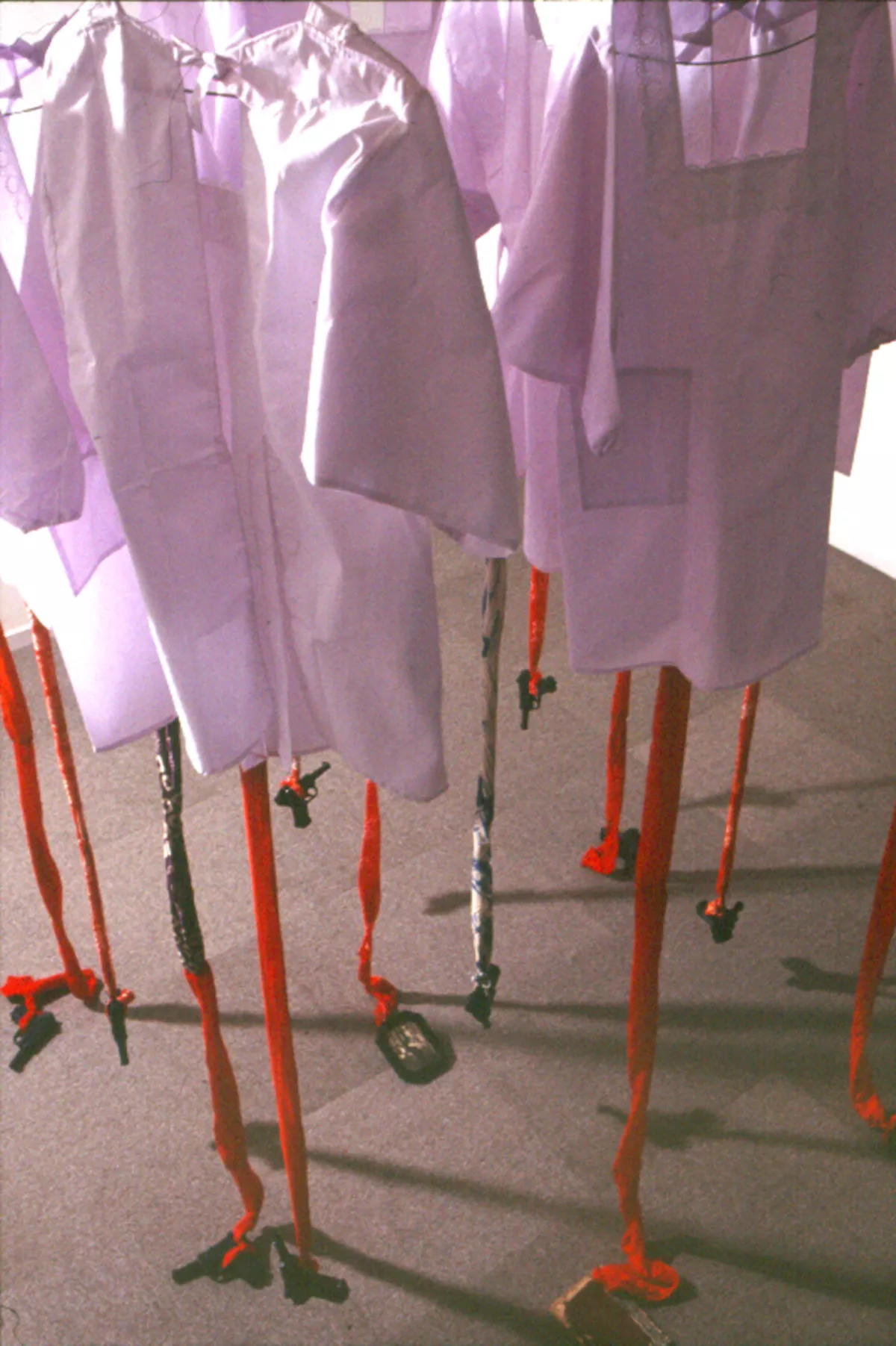
Yoshiko Shimada's imagery explored the role of Japanese women who had contributed to the Imperial war effort, in her attempt to intervene in this often overlooked reality of wartime responsibility.
Yoshiko Shimada's installation aimed to give voices to women who have been historically silenced for generations.
Yoshiko Shimada is not an outsider, producing her work in some safe place; rather, as a Japanese woman she is placed in the ambiguous place of being one of the assailants.
Yoshiko Shimada has been collaborating with BuBu, a performance artist and AIDS activist since 1996.
Yoshiko Shimada has often used drag in her artwork to explore gender roles, considering it a medium through which she can better understand the construction of her own position in society.
Yoshiko Shimada has stated that this installation was her way of resisting the apathy of the younger generation, for whom the war history is being repressed by Japan's older generations and the influence of Japanese nationalism and conservative historical revision of the Japanese education system.
Since 2012, Yoshiko Shimada has been performing Becoming a Statue of a Japanese Comfort Woman.
Yoshiko Shimada has carried out this performance multiple times since 2012 at contested locations in Japan such as the Yasukuni Shrine and the National Diet, as well as in South Korea, and alongside the international feminist art collective Tomorrow Girls Troop in Los Angeles, US, Seoul, South Korea, and Tokyo, Japan.
In 1993 Yoshiko Shimada staged a protest against the Toyama Modern Art Museum for its censorship and destruction of artist Oura Nobuyuki's satirical collage of Emperor Hirohito.
Yoshiko Shimada created an etching of the Showa Emperor with his face scratched out entitled A Picture to be Burned, burned one of the prints, and sent its ashes in a plastic bag to the museum alongside a letter requesting her work be added to their collection.
Yoshiko Shimada is active as a curator in Japan and internationally.
Yoshiko Shimada curated Nakajima Yoshio Syndrome in 2015 at Atsukobarouh gallery in Shibuya, Tokyo, as well as From Nirvana to Catastrophe at Ota Fine Arts in 2017, for which she wrote and edited the exhibition catalogues.