 1.
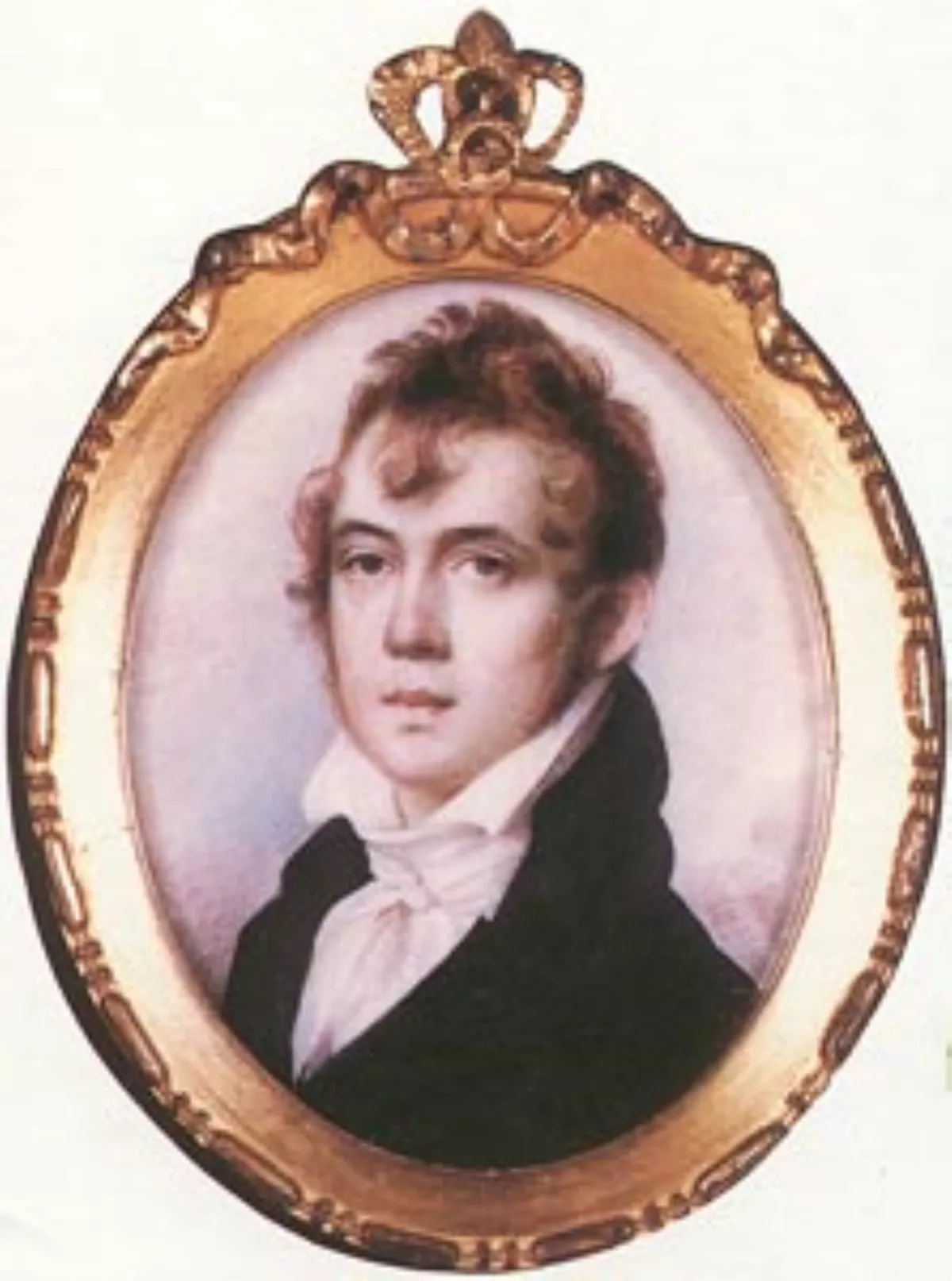
1. Anson Dickinson was an American painter of miniature portraits who achieved fame during his lifetime, producing a very large number of works, but who is largely forgotten.
 1.
1. Anson Dickinson was an American painter of miniature portraits who achieved fame during his lifetime, producing a very large number of works, but who is largely forgotten.
Anson Dickinson was born in Milton, a district of Litchfield, Connecticut, in 1779, son of Oliver Dickinson Junior and Anna Landon Dickinson.
Anson Dickinson did enamel work, made frames and painted signs before becoming a miniature painter.
Anson Dickinson probably met and learned from Elkanah Tisdale in these early years.
On 27 April 1802 Anson Dickinson published an advertisement for miniature portrait painting in the Connecticut Journal, a New Haven newspaper.
The first known painting signed by Anson Dickinson is dated 1803.
In July 1804, Anson Dickinson made a trip to New York City, where Edward Greene Malbone painted his portrait.
Anson Dickinson returned to Connecticut and began painting prominent local people as well as students from the Tapping Reeve Law School and the Litchfield Female Academy founded by Sarah Pierce.
Anson Dickinson began traveling in 1805, a habit that lasted most of his life.
Anson Dickinson met Washington Irving in Albany in 1810, and Irving encouraged him in his work.
Anson Dickinson showed his work in a number of exhibitions between 1811 and 1815.
Anson Dickinson's work was shown at the Pennsylvania Academy of the Fine Arts, the National Academy of Design, the American Academy of the Fine Arts and the Boston Athenaeum.
At several times during his career Anson Dickinson had a studio in New York City.
Anson Dickinson married Sarah Brown in New York City in 1812, and they lived there until 1820, when he resumed traveling.
Anson Dickinson met the famous artist Gilbert Stuart in Boston 1823.
Stuart was unusually impressed by Anson Dickinson, and commissioned him to paint miniatures of himself and his daughter.
Anson Dickinson stayed in Washington, DC from 1827 to 1830, painting portraits of many important political and military leaders.
Anson Dickinson visited and worked in Albany, New York City, Charleston, Boston, Philadelphia, Baltimore, Washington, DC, New Haven, Litchfield, Buffalo and parts of Canada.
Anson Dickinson often returned to visit his family in Milton, and painted portraits of residents of Litchfield.
Anson Dickinson finally returned to Milton for good in 1846, and devoted himself to gardening until his death on 9 March 1852.
Anson Dickinson kept a work book that documents 1,500 subjects that he painted over the fifty years of his career, giving the place and date of each work, and sometimes the price.
Anson Dickinson's subjects included both common people, such as his family members and neighbors, and prominent members of society.
In July 1830 Anson Dickinson was commissioned by George Washington Parke Custis to make a copy of Charles Willson Peale's 1772 "Militia Colonel Portrait" of George Washington.
Anson Dickinson's engraving captured the essence of the original, but was somewhat simplified due to the constraints of the miniature format.
Anson Dickinson advertised the reproductions for sale for one dollar each.
Anson Dickinson was a very handsome, promising young man, but the promise of his youth has not been realized.
Anson Dickinson has led a wandering, irregular life, without credit to himself or his profession.
Anson Dickinson is little-known now and much of his work has been lost.