 1.
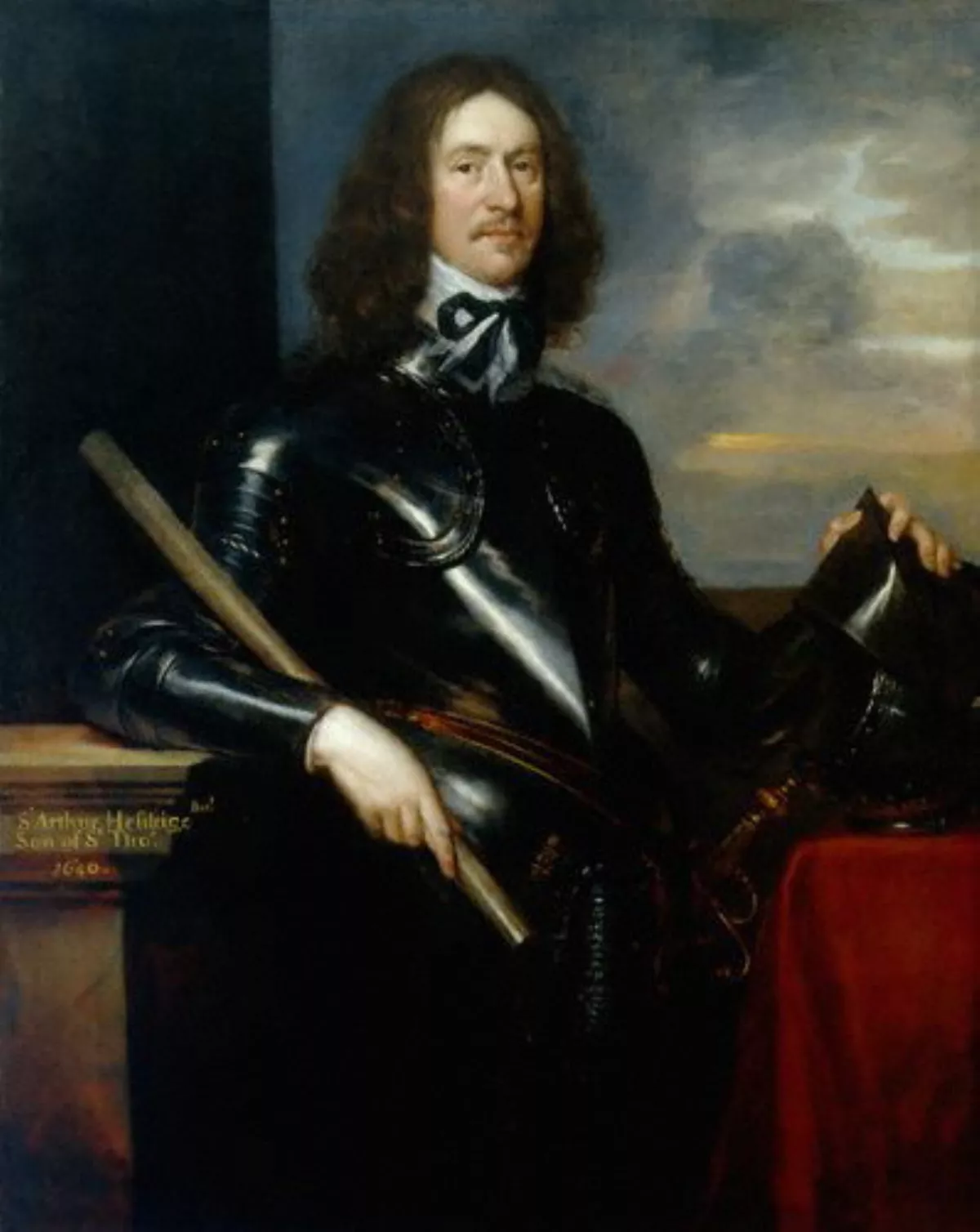
1. Sir Arthur Haselrig, 2nd Baronet was an English politician and eminent heavy cavalry commander.
 1.
1. Sir Arthur Haselrig, 2nd Baronet was an English politician and eminent heavy cavalry commander.
Arthur Haselrig married firstly Frances Elmes, daughter of Thomas Elmes of Lilford Hall, Northamptonshire, by whom he had two sons and two daughters.
Arthur Haselrig married secondly Dorothy Greville, sister of Robert Greville, 2nd Baron Brooke, by whom he had three sons and five daughters.
Arthur Haselrig was very active in the First English Civil War on the Parliamentarian side.
Arthur Haselrig raised a troop of horse for the Earl of Essex and fought at the Battle of Edgehill.
Arthur Haselrig was a commander in the West under William Waller, being nicknamed his fidus Achates, and led his cuirassiers, who were known as the London lobsters.
Arthur Haselrig was shot three times at Roundway Down, with the bullets apparently bouncing off his armour.
The king said that if Arthur Haselrig had been as well supplied as he was fortified he could have withstood a siege.
Arthur Haselrig supported Oliver Cromwell in his dispute with the Earl of Manchester and the Earl of Essex.
Arthur Haselrig approved of the king's execution but declined to act as a judge at his trial.
Arthur Haselrig was one of the leading men in the Commonwealth, but he was antagonised by Cromwell's expulsion of the Rump Parliament, and he opposed the Protectorate refusing to pay taxes.
Arthur Haselrig considered Cromwell to be a traitor to the cause after this as he was a staunch republican and opposed to all rule by a single person whether by hereditary succession or military might.
In 1654, Arthur Haselrig was elected MP for Leicester in the First Protectorate Parliament and in 1656 for the Second Protectorate Parliament, but he was excluded from them both.
Arthur Haselrig refused a seat, offered to him by Cromwell, in the Protectorate House of Lords.
On Cromwell's death Arthur Haselrig refused support to Richard Cromwell, and was instrumental in his downfall.
Arthur Haselrig was elected MP for Leicester for the Third Protectorate Parliament in 1659.
Arthur Haselrig became one of the most influential men in both Council and Parliament.
Arthur Haselrig tried to keep a republican parliamentary administration, "to keep the sword subservient to the civil magistrate".
Arthur Haselrig opposed the schemes of John Lambert who was resisting parliamentary control over the military.
Arthur Haselrig knew the area well having campaigned around Hampshire during the civil war.
Arthur Haselrig, trusting to his assurance of fidelity to the "Good Old Cause" consented to the retirement of his regiment from London.
The Rump Parliament was dissolved and Arthur Haselrig found himself marginalised by the unfolding events.
Arthur Haselrig petitioned for a pardon, claiming he had not supported the overthrow of Charles I and had supported the Commonwealth only to avoid bloodshed.
Arthur Haselrig exposed himself to considerable obloquy by his exactions and appropriations of confiscated landed property, though the accusation brought against him by John Lilburne was examined by a parliamentary committee and adjudged to be false.
In 1646, Arthur Haselrig purchased Auckland Castle, previously home of the Bishop of Durham, and replaced it with a new country house.