 1.
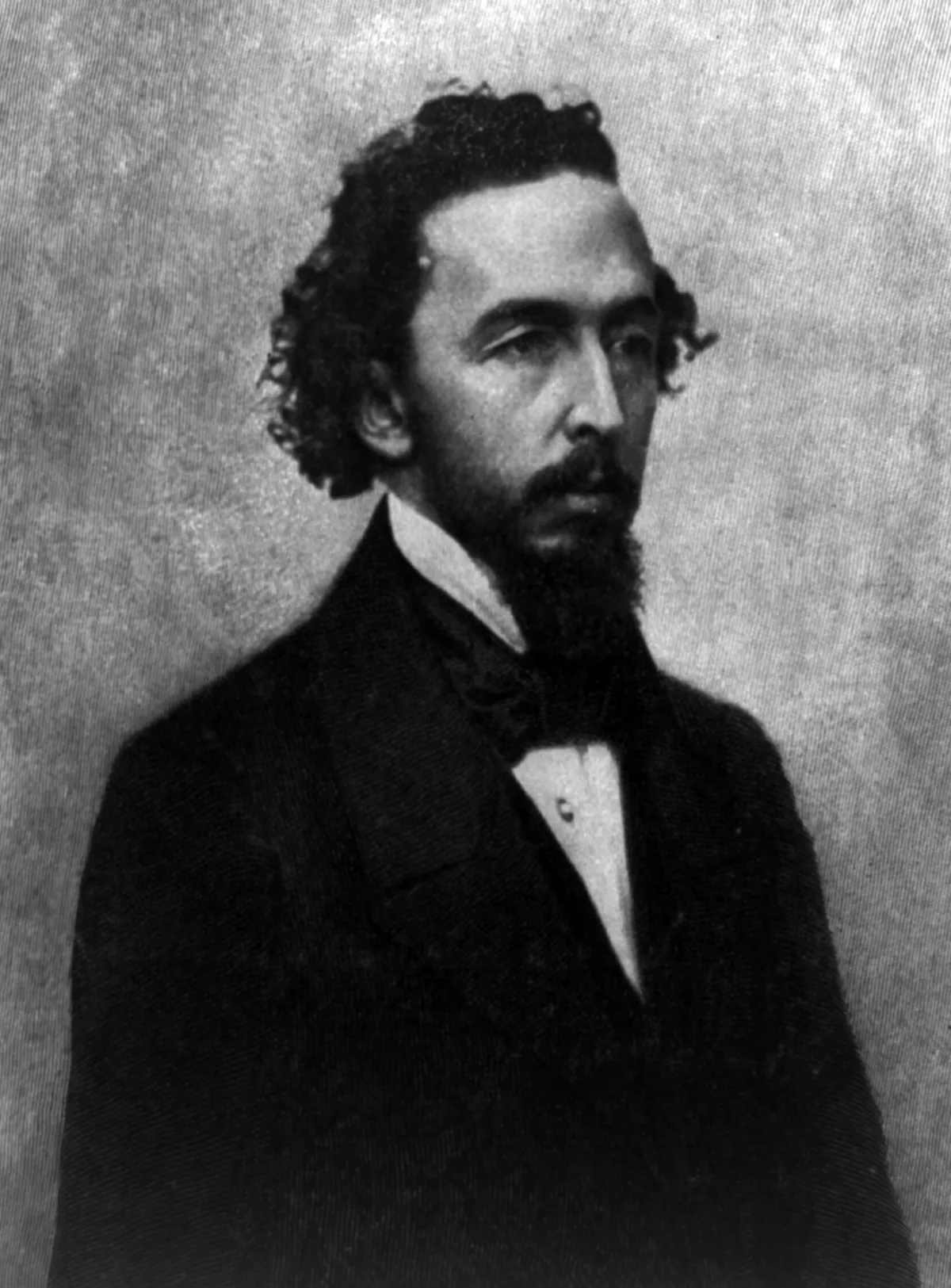
1. Bayard Taylor was an American poet, literary critic, translator, travel author, and diplomat.
 1.
1. Bayard Taylor was an American poet, literary critic, translator, travel author, and diplomat.
Bayard Taylor's travelogues were popular in both the United States and Great Britain.
Bayard Taylor served in diplomatic posts in Russia and Prussia.
Bayard Taylor was the fourth son, the first to survive to maturity, of the Quaker couple Joseph and Rebecca Taylor.
Bayard Taylor's mother was of half Swiss origin Bayard Taylor's father was a wealthy farmer.
Bayard Taylor received his early instruction in an academy at West Chester, Pennsylvania, and later at nearby Unionville.
Bayard Taylor sent accounts of his travels to the New York Tribune, The Saturday Evening Post, and Gazette of the United States.
That same year, Horace Greeley, editor of the New York Tribune, hired Bayard Taylor and sent him to California to report on the gold rush.
Bayard Taylor returned by way of Mexico and published another two-volume collection of travel essays, El Dorado; or, Adventures in the Path of Empire.
In 1849 Bayard Taylor married Mary Agnew, who died of tuberculosis the next year.
Bayard Taylor returned to the US on December 20,1853, and undertook a successful public lecturer tour that extended from Maine to Wisconsin.
In Berlin in 1856, Bayard Taylor met the great German scientist Alexander von Humboldt, hoping to interview him for the New York Tribune.
Bayard Taylor planned to go to central Asia, where Humboldt had traveled in 1829.
Bayard Taylor informed Humboldt of Washington Irving's death; Humboldt had met him in Paris.
In 1859 Bayard Taylor returned to the American West and lectured at San Francisco.
Bayard Taylor published his first novel Hannah Thurston in 1863.
Bayard Taylor's letters describing this adventure were later compiled and published as Colorado: A Summer Trip.
In 1866, Bayard Taylor popularized outlaw James Fitzpatrick as swashbuckling hero Sandy Flash in his novel The Story of Kennett, set in Revolutionary War-era Pennsylvania.
Bayard Taylor spoke at the dedication of a monument to Halleck in his native town, Guilford, Connecticut.
Bayard Taylor imitated and parodied the writings of various poets in Diversions of the Echo Club.
In 1874 Bayard Taylor traveled to Iceland to report for the Tribune on the one thousandth anniversary of the first European settlement there.
On July 4,1876, at the Centennial Exposition in Philadelphia, Bayard Taylor recited his National Ode to an enthusiastic crowd of more than four thousand, the largest audience for a poetry reading in the United States to that date and a record which stood until 1961.
Bayard Taylor's body was returned to the US and buried in Longwood Cemetery, Kennett Square, Pennsylvania.
Bayard Taylor's verse is finished and sonorous, but at times over-rhetorical.
Bayard Taylor felt, in all truth, the torment and the ecstasy of verse; but, as a critical friend has written of him, his nature was so ardent, so full-blooded, that slight and common sensations intoxicated him, and he estimated their effect, and his power to transmit it to others, beyond the true value.
Bayard Taylor had, from the earliest period at which he began to compose, a distinct lyrical faculty: so keen indeed was his ear that he became too insistently haunted by the music of others, pre-eminently of Tennyson.
Bayard Taylor's poetry is striking for qualities that appeal to the ear and eye, finished, sonorous in diction and rhythm, at times too rhetorical, but rich in sound, color, and metrical effects.
Bayard Taylor's fame rests securely upon his unequalled rendering of Faust in the original metres, of which the first and second parts appeared in 1870 and 1871.
Marie Hansen Taylor translated into German Bayard's Greece, Hannah Thurston, Story of Kennett, Tales of Home, Studies in German Literature, and notes to Faust, both parts.