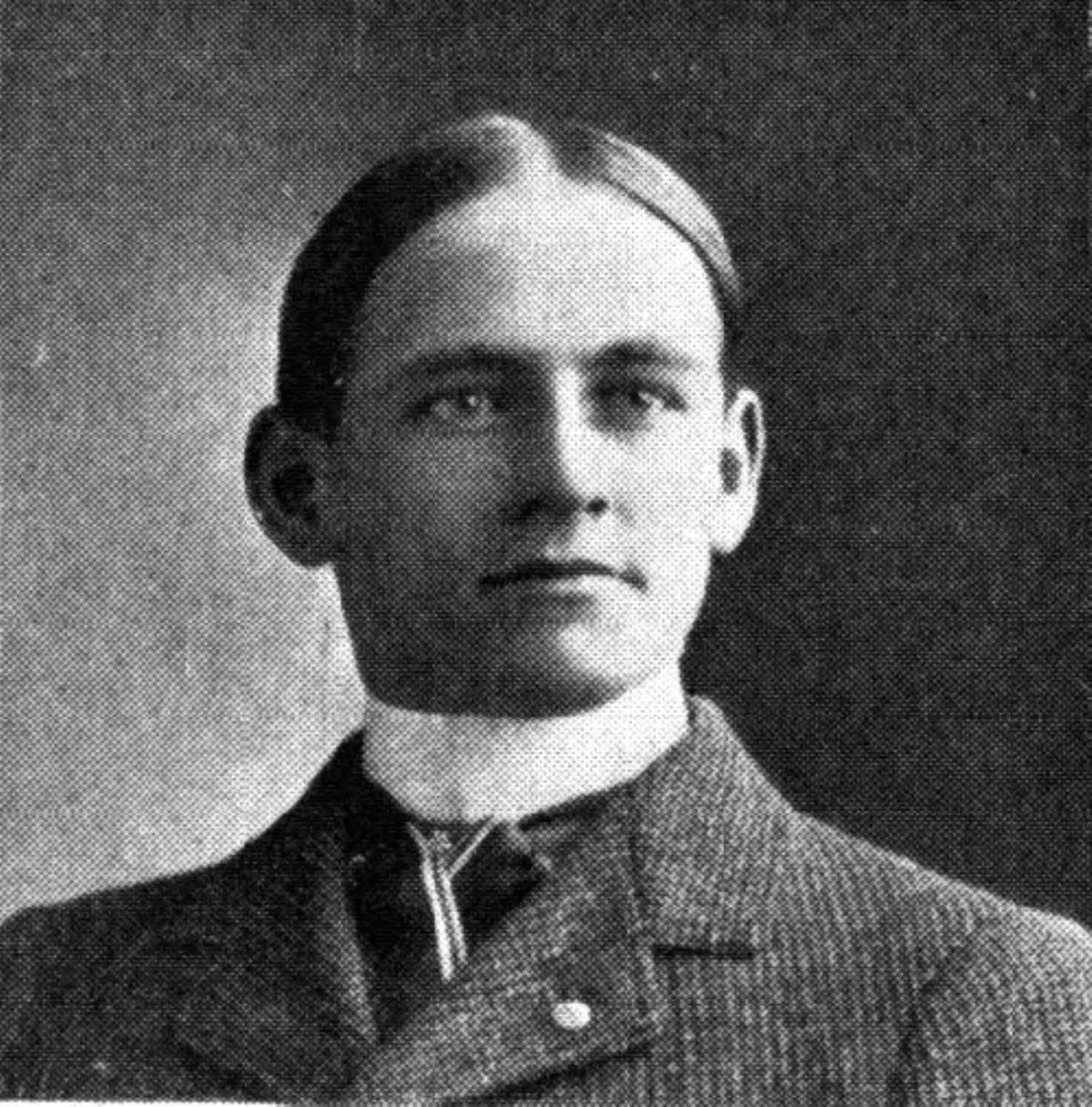
 1.
1. Charles Edward Dvorak was an American track and field athlete who specialized in the pole vault.
 1.
1. Charles Edward Dvorak was an American track and field athlete who specialized in the pole vault.
Charles Dvorak attended the University of Michigan where he competed for the Michigan Wolverines men's track and field team from 1900 to 1904.
Charles Dvorak participated in the 1900 Summer Olympics where he was a favorite in the pole vault.
Charles Dvorak won a special silver medal in a consolation competition.
Charles Dvorak later served as a high school football, basketball and track coach in Seattle, Washington, where he died in 1969 at age 91.
Charles Dvorak was the son of Frank E and Antoinette Dvorak.
Charles Dvorak attended the Lewis Institute in Chicago, considered the first junior college in the United States.
The Encyclopedia of Ethnicity and Sports in the United States credits Charles Dvorak as being one of the earliest Americans of Czech descent to achieve significant success in athletics.
At Michigan, Charles Dvorak worked with track coach Keene Fitzpatrick, who has been credited with inventing modern pole-vaulting technique.
Charles Dvorak returned in the fall as a student in Michigan's law department, earning his law degree in 1904.
Charles Dvorak was a member of four consecutive Western Conference championship track teams from 1901 to 1904 and was the conference pole vault champion in both 1901 and 1903.
In Paris, Charles Dvorak missed the event finals following a controversy over the scheduling of certain event finals for a Sunday.
The pole vault, in which Charles Dvorak was a favorite, was one of the events scheduled for Sunday.
An entirely different account of Charles Dvorak's disqualification was published in October 1900 by The Michigan Alumnus.
Charles Dvorak is known as the first pole vaulter to use a bamboo pole in lieu of the traditional, heavier ash or hickory poles.
Charles Dvorak first used a bamboo pole at the 1900 Summer Olympics.
Charles Dvorak worked with a bamboo pole for approximately a year from 1902 to 1903, though he discarded the bamboo pole for his old pole when he broke the world's record in May 1903.
Charles Dvorak shared his recollection about murmurs that were exchanged when the bamboo pole was introduced.
Charles Dvorak returned to international competition as a member of the United States Olympic team at the 1904 Summer Olympics in St Louis.
Charles Dvorak established a law office in Chicago at the Chamber of Commerce Building at 140 Washington Street.
In January 1908, Charles Dvorak was hired as the athletic director and track coach at the University of Idaho in Moscow, Idaho.
Charles Dvorak is an all-round athlete, has been connected with track for many years, and is thoroughly in touch with the game.
Charles Dvorak spent the months of August and September 1908 in the Big Horn Mountains of Wyoming.
Charles Dvorak had previously announced plans to spend the summer prospecting with an old miner.
In 1910, Charles Dvorak was employed in helping to organize the Union Title and Trust Company of Okanogan County, Washington.
Charles Dvorak was placed in charge of the company's legal and trust work.
In 1912, Charles Dvorak moved from Molson, Washington, to Marcus, Washington.
In February 1918, Charles Dvorak and his wife had a son, Robert Larry Charles Dvorak, who was born in Spirit Lake, Idaho.
In 1920, Charles Dvorak moved to Seattle, Washington, where he was hired as the coach of all athletic teams at Franklin High School.
Charles Dvorak was the football coach at Franklin in 1920 and 1921.
At Franklin, Charles Dvorak coached African-American athlete Brice Taylor, who went on to become an All-American football player at the University of Southern California.
Charles Dvorak is very much admired by pupils and associates.
In 1927, Spalding's Official Pacific Coast Interscholastic Foot Ball Guide reported that "Charles Dvorak, the renowned player of former years on Yost's University of Michigan team," was coach at Roosevelt High School.
In 1934, Charles Dvorak retired from coaching football to devote his time to basketball and track.
In 2008, Charles Dvorak was posthumously inducted into the Michigan Track and Field Hall of Fame.