 1.
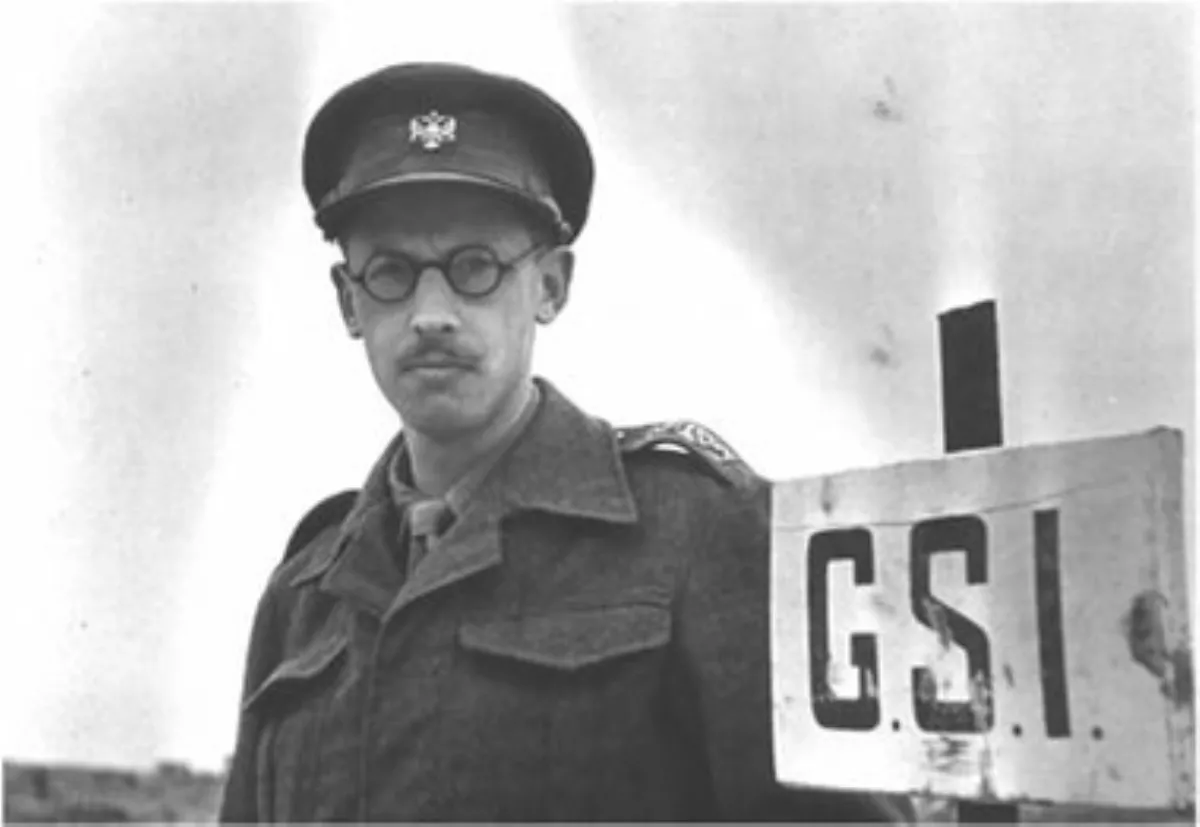
1. Edgar Williams was one of the few officers who was privy to the Ultra secret, and he served on the staff of Field Marshal Sir Bernard Montgomery as his intelligence officer for the rest of the war.
 1.
1. Edgar Williams was one of the few officers who was privy to the Ultra secret, and he served on the staff of Field Marshal Sir Bernard Montgomery as his intelligence officer for the rest of the war.
Edgar Williams was recruited to work in military intelligence by Brigadier Francis de Guingand, who later became Montgomery's chief of staff.
Edgar Williams integrated information from Ultra with that from other sources such as the Y service, prisoner of war interrogations, aerial reconnaissance and ground reconnaissance behind enemy lines by the Long Range Desert Group.
Edgar Williams's father served as a chaplain in the Royal Navy during the Great War, and served on the Western Front.
Edgar Williams secured a postmastership at Merton College, Oxford, where he played soccer and cricket, and obtained a First in modern history in 1934.
Edgar Williams remained at Merton as a Harmsworth senior scholar, then became an assistant lecturer at the Liverpool University in 1936.
Edgar Williams returned to Merton in 1937 as a junior research fellow, studying the Cabinet of the United Kingdom in the 18th century.
Edgar Williams earned a Master of Arts degree in 1938, and commenced work on his PhD, in which he argued that it was the Treaty of Waitangi that granted Britain sovereignty over New Zealand, and the land was not terra nullius.
In 1938 Edgar Williams married Monica Robertson, the daughter of Philip Robertson, a professor from New Zealand.
Edgar Williams was commissioned as a second lieutenant in the 1st King's Dragoon Guards on 21 June 1939.
The division was sent to Cyrenaica, where, on 24 February 1941, Edgar Williams was in command of a troop of C Squadron, 1st King's Dragoon Guards when it was ambushed near El Agheila.
Edgar Williams would prepare his intelligence summaries in the early hours of the morning by the light of a pressure lamp, wearing a crochet jacket that had once belonged to a German general.
When Lieutenant-General Bernard Montgomery assumed command of the Eighth Army in August 1942, he was impressed with Edgar Williams and identified him as the man he wanted to head his intelligence section.
Edgar Williams suggested that if the two could be separated, then it might be possible to break through the Italian forces.
Edgar Williams later explained the difficulty of dealing with intelligence during the German and Italian withdrawal after the battle:.
Edgar Williams remained with Montgomery as his intelligence officer for the rest of the war.
For Operation Overlord, Edgar Williams confronted the formidable task of providing estimates months in advance of a volatile situation.
Edgar Williams's estimates were better than those of any other analyst.
Edgar Williams slightly underestimated German capabilities, but correctly predicted the strength of German infantry and armoured divisions.
Edgar Williams was mentioned in despatches three times, and was awarded the Distinguished Service Order on 1 June 1943, appointed a Commander of the Order of the British Empire on 29 June 1944, and made a Companion of the Order of the Bath on 24 January 1946.
Edgar Williams was elected a Fellow of Balliol College, Oxford in 1945, but he never completed his work on the 18th century British cabinet.
Edgar Williams only wrote three of its articles, on Winston Churchill, Lord Montgomery and Carton de Wiart.
Edgar Williams went on to become warden of Rhodes House in 1952, a position which he held until 1980.
Edgar Williams relinquished his reserve commission on 20 November 1962, having reached the mandatory retirement age, but retained his rank of brigadier.
At Oxford, Edgar Williams was a member of the Hebdomadal Council, a Curator of the Chest, and latterly a Pro-Vice-Chancellor.
Edgar Williams served as a Radcliffe Trustee, as a member of the Nuffield Provincial Hospitals Trust, and as chairman of the Academic Advisory Board which planned Warwick University.
Edgar Williams loved cricket, and served for many years as senior treasurer of the Oxford University Cricket Club.
Edgar Williams was appointed a Deputy Lieutenant for Oxfordshire in 1964, and was knighted in the 1973 New Year Honours.
Edgar Williams worked for the United Nations Security Council Secretariat in New York from 1946 to 1947.
Edgar Williams's papers relating to his service with the United Nations are in the Bodleian Library at Oxford University; those relating to his correspondence with Montgomery are in the Imperial War Museum.