 1.
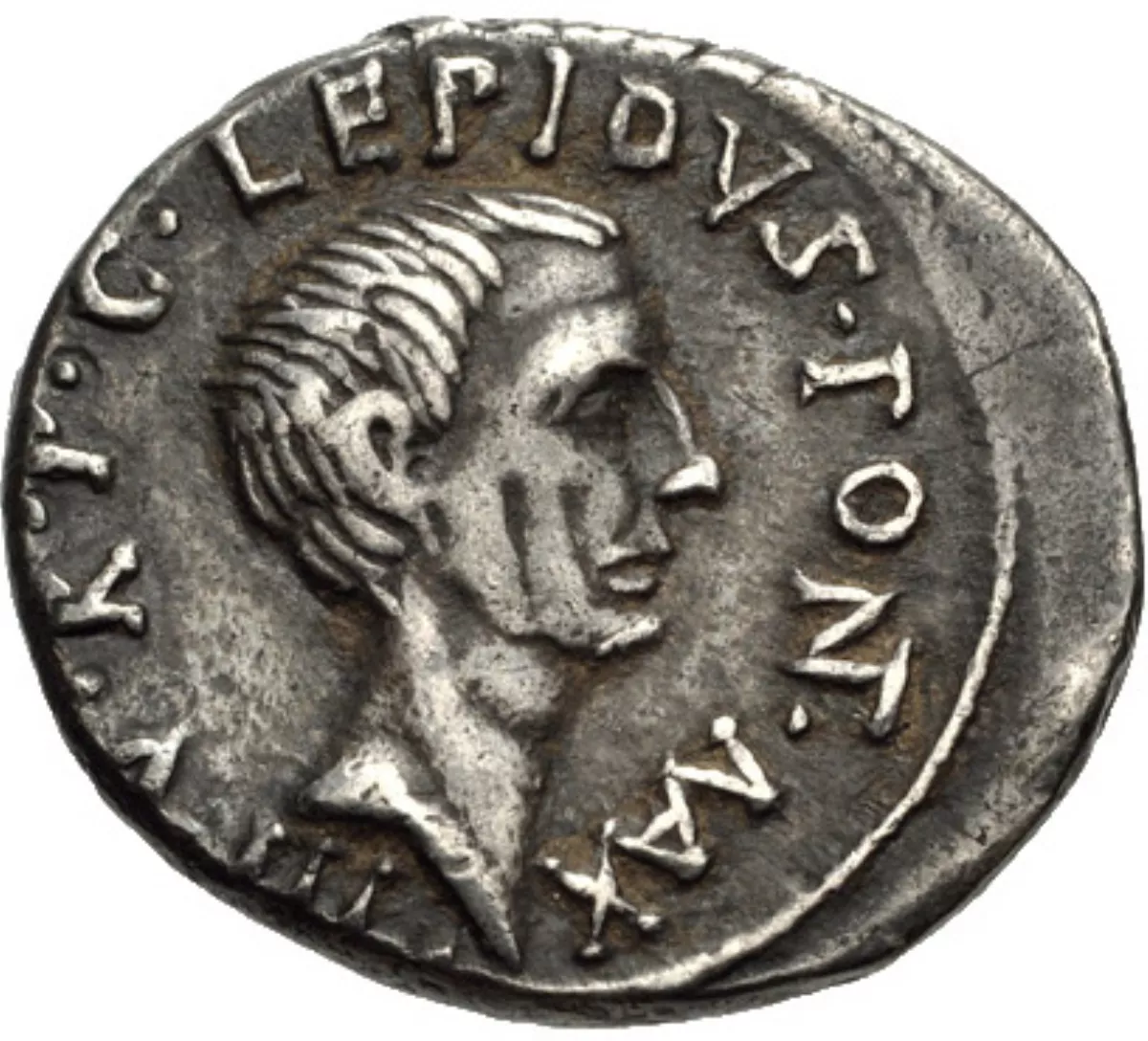
1. Marcus Aemilius Lepidus was a Roman general and statesman who formed the Second Triumvirate alongside Octavian and Mark Antony during the final years of the Roman Republic.
 1.
1. Marcus Aemilius Lepidus was a Roman general and statesman who formed the Second Triumvirate alongside Octavian and Mark Antony during the final years of the Roman Republic.
Lepidus had previously been a close ally of Julius Caesar.
Lepidus was the last pontifex maximus before the Roman Empire, and the last interrex and magister equitum to hold military command.
Lepidus typically appears as a marginalised figure in depictions of the events of the era, most notably in Shakespeare's plays.
Lepidus's brother was Lucius Aemilius Lepidus Paullus.
Lepidus married Junia Secunda, half-sister of Marcus Junius Brutus and sister of Marcus Junius Silanus, Junia Prima and Junia Tertia, Cassius Longinus's wife.
Lepidus was appointed as a praetor in 49 BC, being placed in charge of Rome while Caesar defeated Pompey in Greece.
Lepidus secured Caesar's appointment as dictator, a position that Caesar used to get himself elected as consul, resigning the dictatorship after eleven days.
Lepidus was rewarded with the position of propraetor in the Spanish province of Hispania Citerior.
Lepidus was nominated interrex by the Senate in 52, being the last known Roman to hold this office.
In Spain, Lepidus was called upon to quell a rebellion against Quintus Cassius Longinus, governor of neighbouring Hispania Ulterior.
Lepidus refused to support Cassius, who had created opposition to Caesar's regime by his corruption and avarice.
Lepidus negotiated a deal with the rebel leader, the quaestor Marcellus, and helped to defeat an attack by the Mauretanian king Bogud.
Lepidus was rewarded with the consulship in 46 after the defeat of the Pompeians in the East.
Lepidus appears to have been genuinely shocked when Antony provocatively offered Caesar a crown at the Lupercalia festival, an act that helped to precipitate the conspiracy to kill Caesar.
One of the ringleaders of the conspiracy, Gaius Cassius Longinus, had argued for the killing of Lepidus and Mark Antony as well, but Marcus Junius Brutus had overruled him, saying the action was an execution and not a political coup d'etat.
Lepidus proposed using his army to punish Caesar's killers, but was dissuaded by Antony and Aulus Hirtius.
Lepidus thereafter administered both Hispania and Narbonese Gaul as proconsul.
Lepidus continued to assure the Senate of his loyalty, but engaged in negotiations with Antony.
Lepidus negotiated an agreement with him, while claiming to the Senate that he had no choice.
Antony and Lepidus now had to deal with Octavian Caesar, Caesar's great-nephew, who had been adopted by Caesar in Caesar's will.
Antony and Lepidus met with Octavian on an island in a river, possibly near Mutina, but more likely near Bologna.
At the beginning Lepidus was confirmed in possession of both the provinces of Hispania, along with Narbonese Gaul, but agreed to hand over seven of his legions to Octavian and Antony to continue the struggle against Brutus and Cassius, who controlled the eastern part of Roman territory.
Lepidus was to become consul and was confirmed as Pontifex Maximus.
Lepidus would assume control of Rome while they were away.
Lepidus had in fact already reached the peak of his power.
Lepidus agreed to the proscriptions that led to the death of Cicero and other die-hard opponents of Caesar's faction.
However, Cassius Dio hints that Lepidus helped Paullus to escape.
Lepidus appears to have encouraged the Romanisation of Thibilis in Numidia and to have demolished illicit extensions to Carthage.
Lepidus had been the first to land troops in Sicily and had captured several of the main towns.
Lepidus asserted that Sicily should be absorbed into his sphere of influence.
Octavian accused Lepidus of attempting to usurp power and fomenting rebellion.
The younger Lepidus was executed, but the former triumvir himself was left unmolested.
Lepidus had to plead with his former enemy Lucius Saenius Balbinus to grant her bail.
Weigel argues that these views are coloured by evidence that was in large part politically motivated, and that Lepidus's career was no more perfidious or inconsistent than that of the other major players in the power struggles at the time.
Lepidus argues that his power bid over Sicily was logical and justifiable.
Lepidus appears in several 18th century French plays, such as Prosper Jolyot de Crebillon's Le Triumvirat, ou la mort de Ciceron, in which he attempts to save Cicero's life, and is portrayed as a conflicted figure, who respects traditional Roman values, but is unable to resist the will of his colleagues.
Cicero rejects compromise, but Lepidus is too weak to do so.
Lepidus is the principal character of Alfred Duggan's 1958 historical novel Three's Company.
Lepidus is mentioned in Robert Harris' Dictator, told from the perspective of Cicero's secretary Tiro.
Lepidus is depicted as a general sent to defeat the weakened Antony after Mutina.
Lepidus appears sporadically as a barely-noticed participant in later discussions about future plans.