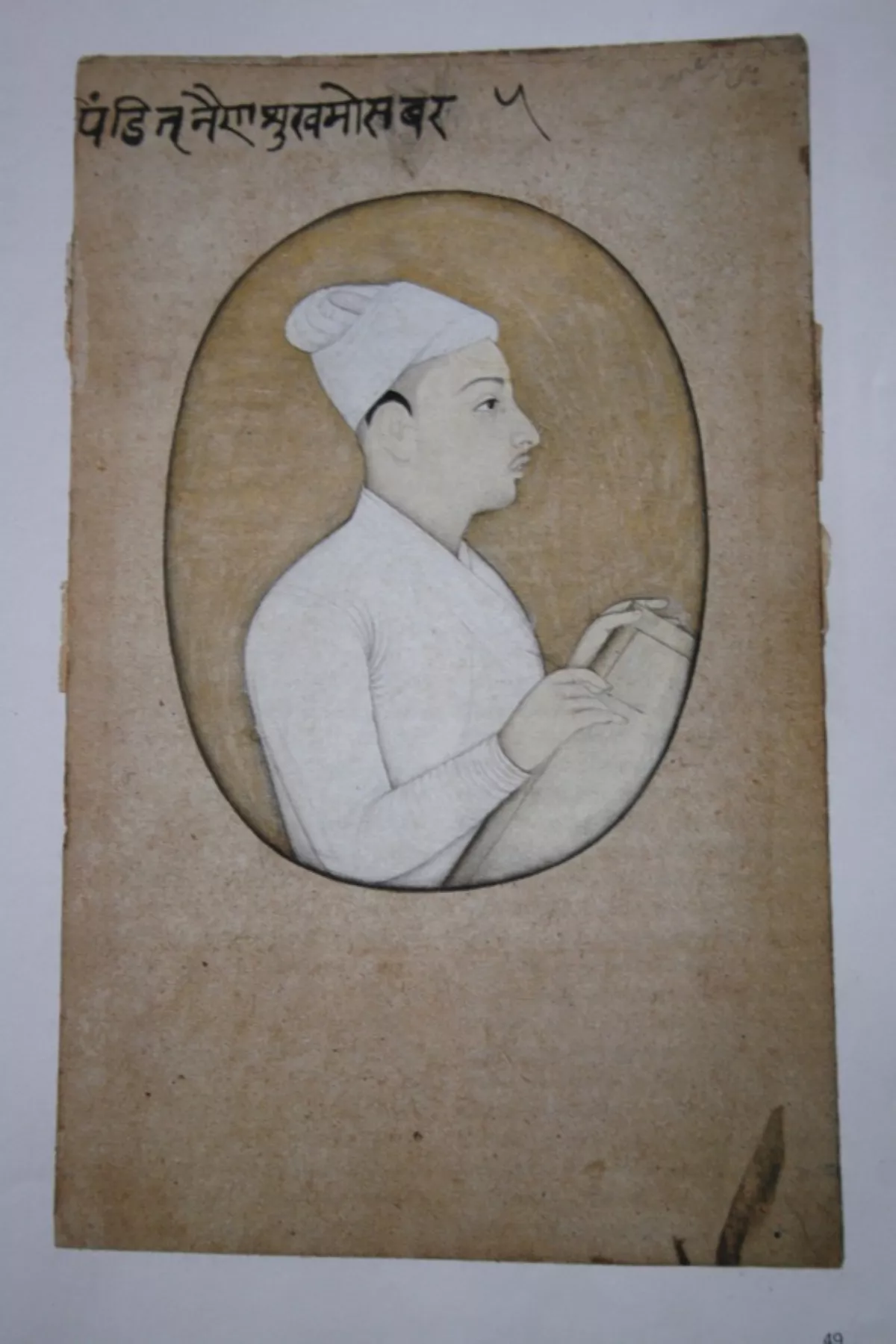
 1.
1. Nainsukh was the younger son of the painter Pandit Seu and, like his older brother Manaku of Guler, was an important practitioner of Pahari painting, and has been called "one of the most original and brilliant of Indian painters".
 1.
1. Nainsukh was the younger son of the painter Pandit Seu and, like his older brother Manaku of Guler, was an important practitioner of Pahari painting, and has been called "one of the most original and brilliant of Indian painters".
Nainsukh was born c 1710 in Guler in modern Himachal Pradesh, India, then the capital of the pocket Guler State in the far north of India, in the foothills of the Himalayas.
At this very time, examples of Moghul painting were increasingly coming to the valleys of the west Himalayas, and it seems probable that Nainsukh came into contact with the works of Mughul painters early on.
Unlike his stylistically more conservative brother Manaku, who remained in Guler and closely conformed to the style of his father Seu, Nainsukh introduced many of the novel elements of Moghul painting into the traditional Pahari style employed by his family.
Around 1740, Nainsukh left his father's workshop in Guler and moved to Jasrota.
The relationship between the art-loving Balwant Singh and Nainsukh must have been very close, since Nainsukh seems to have been employed by him often and able to see and record intimate scenes of his everyday life.
Nainsukh painted a miniature which probably shows the raja's ashes, ceremonially arranged in a screen tent in the countryside with two attendants, presumably at a resting place while on their way to Haridwar.
For him, Nainsukh produced entirely different kinds of work, turning to the more typical Pahari subject matter of illustrating poems recounting the stories from the great Hindu religious epics.
Nainsukh began to make drawings for a set of illustrations to the Gita Govinda, a famous poem on the earthly exploits of Krishna.
Some late sheets by Nainsukh that were not taken beyond the stage of preliminary drawings have comments by priests and scholars on the appropriateness of the images and their faithfulness to the texts they illustrate.