 1.
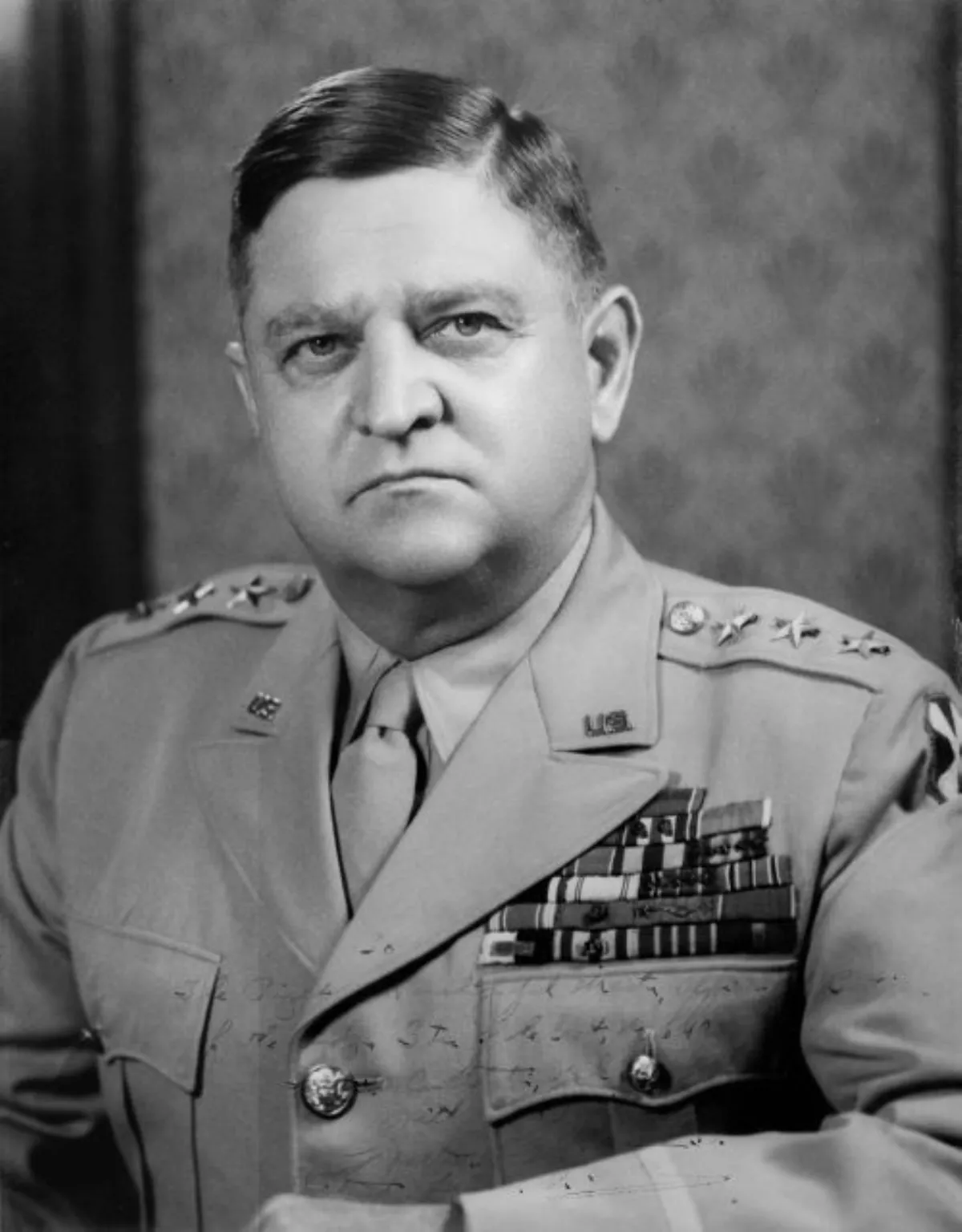
1. Walton Harris Walker was a United States Army four-star general who served with distinction in World War I, World War II, and the Korean War, where he commanded the Eighth United States Army before dying in a jeep accident.
 1.
1. Walton Harris Walker was a United States Army four-star general who served with distinction in World War I, World War II, and the Korean War, where he commanded the Eighth United States Army before dying in a jeep accident.
Walton Walker received two Distinguished Service Crosses for extraordinary heroism in World War II and the Korean War.
Walton Walker graduated from the Wedemeyer Academy, a school which operated in Belton from 1886 to 1911.
Walton Walker attended the Virginia Military Institute in preparation for his education at the USMA.
Walton Walker entered the Academy on 15 June 1907, but resigned on 7 October 1907.
Walton Walker reentered the Academy on March 3,1908, and was commissioned a second lieutenant of Infantry on 12 June 1912.
Walton Walker was a member of the 1914 Veracruz expedition under Brigadier General Frederick Funston; patrolling on the US-Mexican border in 1916, he developed a close friendship with Dwight D Eisenhower.
Walton Walker was promoted to captain on 15 May 1917, a few weeks after the American entry into World War I Walton Walker served at Camp Funston, Texas, from May to December 1917, and Fort Sam Houston with the 13th Machine Gun Battalion from December 1917 to April 1918.
Walton Walker was awarded two Silver Stars for gallantry in action.
Walton Walker attended the Command and General Staff School at Fort Leavenworth, Kansas, from September 1925 to June 1926.
Walton Walker then served at Fort Monroe, Virginia, from June 1926 to July 1930.
Walton Walker next commanded the 2nd Battalion, 15th Infantry at Camp Burrowes, Qinhuangdao and American Barracks, Tianjin, China, from September 1930 to March 1933.
Walton Walker was promoted to lieutenant colonel on 1 August 1935, and, after attending the United States Army War College from August 1935 until June 1936, he served as post executive officer and then brigade executive officer with the 5th Infantry Brigade, 3rd Division, from August 1936 to June 1937; the brigade was commanded by George C Marshall, the future Army Chief of Staff.
Walton Walker served as a staff officer in the War Plans Division with the General Staff Corps in Washington, DC from August 1937 to April 1941.
Walton Walker next served as commanding officer of the 36th Infantry Regiment, which was activated 15 April 1941, as the 36th Infantry and assigned to the 3rd Armored Division, June 1941; on 1 January 1942, it was redesignated the 36th Armored Infantry.
When Marshall assigned George S Patton to organize America's armored forces, Walker successfully lobbied Marshall for a post as one of Patton's subordinate commanders, gaining promotion to brigadier general in the process.
Walton Walker was awarded a Silver Star for gallantry in action on 7 July 1944.
When Infantry troops of the XX Corps launched an attack across the Vire River in the vicinity of Airel, 7 July 1944, and came under intensive enemy fire, General Walton Walker made repeated visits to the disputed sector and exposed himself to mortar and artillery concentrations at the front in order to encourage the officers and men making the crossing.
General Walton Walker's conduct reflects credit upon himself and the military service.
Walton Walker received the Distinguished Service Cross for extraordinary heroism on 23 August 1944, the citation for which read:.
On 23 August 1944, Maj General Walton Walker, Commanding General, XX United States Army Corps, with complete disregard for his own safety, personally directed the successful operation which established a bridgehead across the Seine River near Melun, France.
Walton Walker repeatedly exposed himself to this enemy fire, encouraging the troops to move forward and by doing so gave them the required confidence to continue their advance.
Walton Walker's troops saw heavy fighting in France and Germany during the remainder of the war, especially at Metz, the Battle of the Bulge, and in the invasion of Germany.
Walton Walker received the unconditional surrender of Generaloberst Lothar Rendulic, commander of German Army Group South, on 7 May 1945.
Walton Walker was given command of the Eighth Service Command, headquartered in Dallas, from May 1945 to May 1946.
Walton Walker was assigned as the commander of the Sixth Service Command and the Fifth Army, headquartered in Chicago, from May 1946 to September 1948, and then became commanding general of the US Eighth Army, the American occupation force in Japan.
Walton Walker was ordered by General Douglas MacArthur, the Supreme Allied Commander in Japan, to restore the peacetime Eighth Army to combat-ready condition.
Walton Walker's situation was not helped by MacArthur's unrealistic demands from Tokyo for him not to retreat an inch.
Walton Walker was able to quickly shift his units from point to point, stopping North Korean attacks before they could be reinforced.
Walton Walker kept his main units deployed on the front lines, while retaining other US Army and Marine Corps forces as a mobile reserve.
Walton Walker received reinforcements, including the Provisional Marine Brigade, which he used along with the Army's 27th Infantry Regiment as "fire brigades," reliable troops who specialized in counterattacking and wiping out enemy penetrations.
Walton Walker was awarded the Distinguished Service Cross for extraordinary heroism from 14 July to 28 September 1950.
Lieutenant General Walton Walker distinguished himself by extraordinary heroism in action against enemy aggressor forces in the Republic of Korea from 14 July to 28 September 1950.
Walton Walker was killed in a traffic accident on 23 December 1950, in Dobong District, Seoul, South Korea, when his north-bound command jeep collided with a south-bound weapons carrier from a South Korean army division that had swung out of its lane.
Walton Walker's body was escorted back to the United States by his son Sam Sims Walker, then a Company commander with the 19th Infantry Regiment, who was serving in Korea.
In 1963, South Korea President Park Chung Hee honored Walton Walker by naming a hill in the southern part of Seoul after him.
Today, Walton Walker Hill is the site of the Grand Walton Walker Hill, a five-star international resort and hotel with its own full service casino.
Walton Walker was portrayed by Douglas Fowley in the 1963 film Miracle of the White Stallions, and by Garry Walberg in the 1977 film MacArthur.