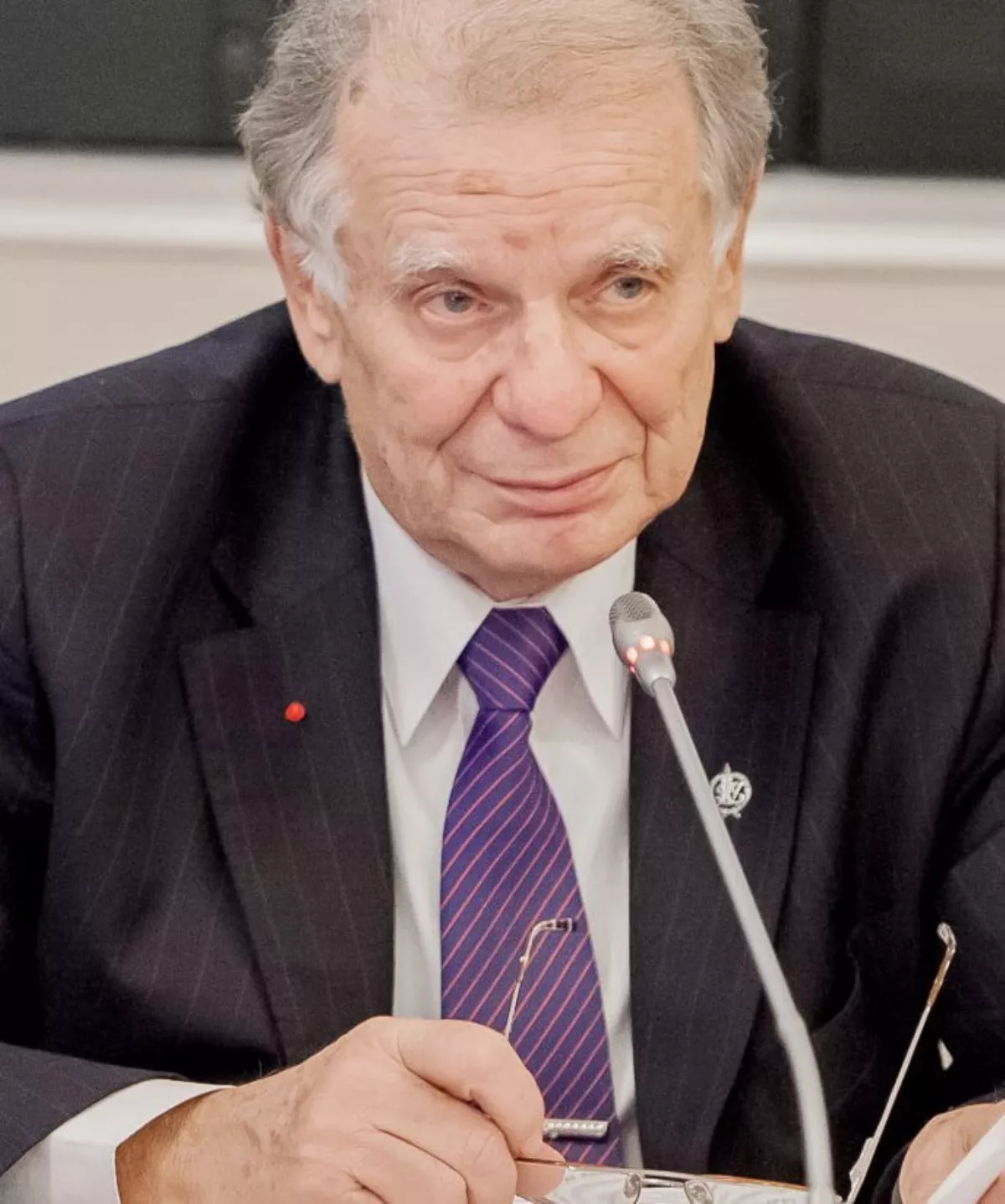
 1.
1. Zhores Alferov shared the 2000 Nobel Prize in Physics for the development of the semiconductor heterojunction for optoelectronics.
 1.
1. Zhores Alferov shared the 2000 Nobel Prize in Physics for the development of the semiconductor heterojunction for optoelectronics.
Zhores Alferov became a politician in his later life, serving in the lower house of the Russian parliament, the State Duma, as a member of the Communist Party from 1995.
Zhores Alferov was named after French socialist Jean Jaures while his older brother was named Marx after Karl Marx.
Zhores Alferov graduated from secondary school in Minsk in 1947 and enrolled in the Belarusian Polytechnic Academy.
Zhores Alferov then served as the director of the Ioffe Institute from 1987 to 2003.
Zhores Alferov was elected a corresponding member of the Academy of Sciences of the Soviet Union in 1972, and a full member in 1979.
Zhores Alferov's contribution included work on germanium diodes for use as a rectifier.
In 1963, Zhores Alferov filed a patent application proposing double-heterostructure lasers; Herbert Kroemer independently filed a US patent several months later.
In 1966, Zhores Alferov's lab created the first lasers based on heterostructures, although they did not lase continuously.
In 1987, Zhores Alferov became the fifth director of the Ioffe Institute.
In 1989, Zhores Alferov gained the administrative position of chairman of the Leningrad Scientific Center, now referred to as the St Petersburg Scientific Center.
Zhores Alferov worked to foster relationships between early educational institutions and scientific research institutions to train the next generation of scientists, citing Peter the Great's vision for the Russian Academy of Sciences to be organized with a scientific research core in close contact with a gymnasium.
In 1997 Zhores Alferov founded the Research and Education Center at the Ioffe Institute and in 2002, this center officially became the Saint Petersburg Academic University after gaining a charter to award masters and PhD degrees.
The primary research charter of the Saint Petersburg Academic University, which Zhores Alferov founded, was the development of nanotechnology.
Zhores Alferov provided a consistent voice in parliament in favor of increased scientific funding.
Zhores Alferov was re-elected in 2003 and again in 2007, when he was placed second on the party's federal electoral list behind Gennady Zyuganov and ahead of Nikolai Kharitonov, even though he was not a member of the party.
Zhores Alferov died at the age of 88 on 1 March 2019.
Zhores Alferov was an atheist and expressed objections to religious education.
Zhores Alferov was one of the signers of the open letter to President Vladimir Putin from members of the Russian Academy of Sciences against clericalisation of Russia.